
About: Susan Rubin has been writing and producing plays for 20 years. Her work has been performed in New York, Los Angeles, San Francisco, Baltimore, and Cuba, and her works have been produced at the New York Theater Workshop, Baltimore Center Stage, the Los Angeles Theatre Center, where she was in residence for 6 years, and LA’s Bootleg and Circle X theaters. Rubin has written nine fully produced plays winning recognition from the Los Angeles Times and LA Weekly and prestigious Garland and Ovation awards, and she received 20 years of support and commissions from the Los Angeles County Arts Commission and the Cultural Affairs Department of Los Angeles. More details – https://susanrubinwriter.com/about-susan-rubin/
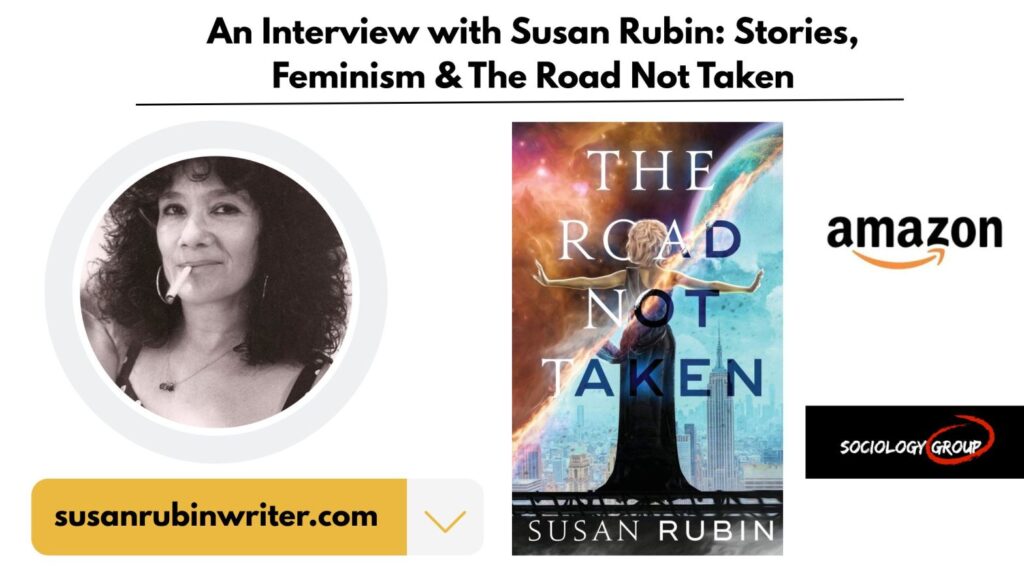
Welcome to our interview series.
Sometimes certain conversations feel like a coincidence, and this feels like one of them. We had hoped to bring meaningful voices and inspiring stories into our series, and it is truly an honor to welcome you, Susan Rubin.
Your journey across theater, documentary filmmaking, comedy writing, and feminist fiction has touched many important human experiences, and we are delighted to have you with us today. We look forward to learning more about your journey and stories.
- Susan, before we begin talking about your journey and work, if you had to describe yourself in just three words, which three would you choose, and why?
Smart. Serious. Funny.
Intellect is important to me, and is a quality that I’ve honed and stays with me as I age, unlike physical characteristics that I have less control over. I value how my mind works. It often leans toward the serious. I take in the world deeply – every part of it, for my entire life. I feel things deeply, and don’t sleep much with concern about the people and issues I care about. So I’ve also cultivated a sense of humor to survive. As a child, it was how I got attention in my large family. It had always been a way to for me to connect and become an important part of my storytelling.
- You have worked in very different creative spaces. Did moving between comedy, documentary work, and fiction change the way you understand people and their stories?
I don’t think it changed how I understand people and their stories; it did change how I retold them through my work. I’m naturally empathetic, curious, and a truth-seeker. All the work is built on a foundation of some kind of truth. Obviously the documentaries were fact-based and research-driven, but how we told those difficult stories came from years of feminist activism and knowing which facts might drive change. The best comedy is based in truth, and trying to get attention using humor but even that work came from a place of empathy. My books, ultimately, are about understanding myself, and through that exploration I learn more about people through the characters I create to represent them.
- You created documentaries on domestic violence, reproductive rights, and women’s experiences. Were there any stories or moments that stayed with you long after the projects ended?
We visited a Rape Crisis Center for a story. There were a little girl and her mother in the waiting room. I assumed the mother was the victim. But when the counselor came out, she took the little girl with her. She was the victim. She was four years old.
- You spent many years building and creating through Indecent Exposure Theater Company. Looking back, what do you feel that journey gave you personally?
Strength.
I was a woman writing for theater in a male-filled world. I was looked at differently; men ran companies. But then, so did I. I did everything: write, direct, produce, cast, administration, funding. The grants I was able to get put me in a position to pay my artists. When you control the money, it makes you both “the person to please” and the one with the responsibility.
- Theater brings writers face-to-face with audiences in real time. What did the stage teach you about human emotions and reactions?
I learned not to take the lack of a laugh, or the silence to a monologue, personally. Audiences keep a lot to themselves. With comedy, you might kill one night, and get no response the next. I wrote a play about women facing cancer (there was a time when I and ten of my friends were all diagnosed, and very few of us survived). In the show there was a monologue and at one show, a woman ran out of the theater and into the lobby to break down in tears.
Sometimes the audience seems to feed off of each other. Some people might find a joke funny but they aren’t laughers. Some folks can be devasted by a scene but they aren’t criers.
Do you change the material based on one night of response? Sometimes I would tweak a line, but generally not because you never ever can tell. They are strangers when they walk in the door.
- Your work often focuses on women’s experiences and voices. Over the years, have you noticed changes in the way people listen to and respond to these stories?
Yes. The documentaries were based on news stories about how women are treated internationally. We would take deeper, more intimate dives and share horrific facts that wouldn’t make the evening news. Many organizations were founded to address the abuses we highlighted (particularly in response to our child bride story). Women were inspired to take action.
There’s so much news available to us now, I think people might be overwhelmed, unsure what to do. I don’t think people don’t care, but I do think people are exhausted.
- The Road Not Taken begins with a woman entering an unexpected new chapter in her life. What inspired you to begin her journey at that point?
I wanted to write something magical. But I was lost about how to do it. I started by writing about Bloomingdale’s because it was part of my childhood; going to Bloomingdale’s when I was young was like going to Starbucks now. It had all kinds of wonderful things to look at, to try on, to smell. It was full of wonder and I was naturally curious.
So, I put Deborah in Bloomingdale’s to see what she finds. She found memories. She found possibilities.
- You have written plays, documentaries, comedy pieces, and now fiction. Which form of storytelling surprises you the most as a writer?
Fiction. You have to plan a play. You can free-write the dialogue, but you can’t free-write the story. Documentaries are rather structured. Even comedy has some rules. When I write my books, I don’t outline, or plan. Memories can be inspiration. Sometimes one memory will jog another, which is a surprise. Sometimes I have to do research, and I’m constantly falling down rabbit holes of history, learning fascinating things that color the worlds I’m writing about. But when I have a blank page in front of me and no plan other than to let the conjuring begin, what winds up on that page is always a surprise.
- If you had the chance to travel through time and space like the characters in your book, where would you go and who would you want to meet?
I would go as far forward in time to when all living beings live in peace and harmony. A gentle world without violence and bloodshed, and the ability for all to survive without having to harm another. I would want to meet anyone in that world!
- Many people quietly wonder about paths they did not take in life. Do you think curiosity about “what could have been” is a universal feeling?
I think most people fantasize about alternative possibilities. I especially think people imagine bigger, better possibilities for themselves. Maybe it’s about regrets. Maybe it’s to find motivation to do something better or to find meaning.
I don’t know if that’s inherent to being a human or if social media and advertising create ways for people to feel inadequate or incomplete.
As I get older, and the people around me get older, I do think about “what ifs” sometimes. I’ve led an unconventional life, and was able to follow the beat of my inner drummer. But what if I had an office job, had children, had a yearly island vacation? It takes strength and courage to be present, and continue to follow your drum beat.
- Through your creative journey, what have you discovered about yourself that surprised you?
That I am a writer. I didn’t want to be a writer. They aren’t the star of the show. I studied dance my whole life. I wanted the dance solo. I wanted to be an actress. Specifically, on a TV show.
Over and over again, I was told I didn’t look right. “You’re a good actress/singer/dancer” but I looked unusual – dark, ethnic, not perky. My mentor, Ronnie, was a creative force in the alternative art scene in the Bay Area. He told me – and I did not appreciate hearing it – that I needed to give up the performance dreams because my brain makes me an incredible writer.
All these years later, I am embracing myself as a writer. I want to take that woman in my book where I want to take her. She can’t go anywhere without me because I’m the writer. And now I believe the writer is the star of the show.
- Are there any new projects, books, or creative ideas that you are currently working on that readers can look forward to?
I am writing a book about two teenaged girls who meet in dreamland. One’s life has already ended in the massacre of her entire family in the early 1900s, but she needs to find her way back to her family in the afterlife. To do that, her distant, alive cousin must hear the story about the family and their tragic end, so that the truth can be told and her cousin can rest in peace.
- Looking ahead, are there any writers, filmmakers, artists, or organizations you would love to collaborate with in the future?
My novel 44 Horatio Street is being shopped to agents right now. It’s important for me to have that book published. It’s a fictionalized version of my childhood in New York City and the Beat poets play a huge part in the story. So, it’s historical fiction. I really want to partner with a tenacious, thoughtful agent to shepherd this book to a publisher. Penguin, Norton, Algonquin are on my wish list.
- For young writers and storytellers who want to create meaningful work but often struggle with self-doubt, what advice would you give them?
TRUST YOURSELF AND TRY. NOBODY ISN’T SCARED.

We believe in sharing knowledge with everyone and making a positive change in society through our work and contributions. If you are interested in joining us, please check our ‘About’ page for more information