
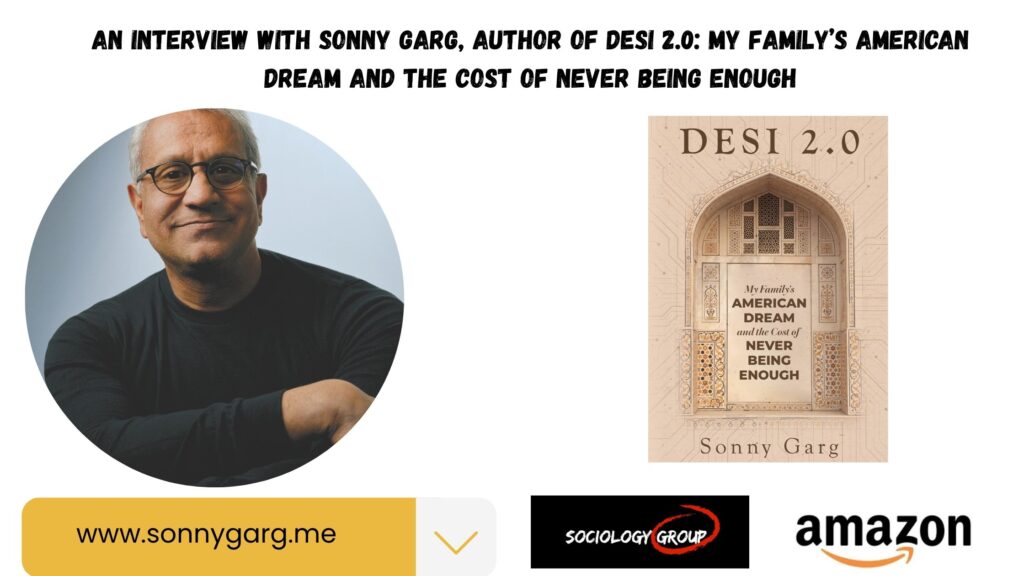
About Author: Sonny Garg is a former Fortune 125 C-Suite executive with over 30 years’ experience examining conventional thinking to transform mature organizations and build new ones across the private, public, and nonprofit sectors. He is Distinguished Executive-in-Residence at the University of Chicago Booth School of Business, a White House Fellow, and an Aspen Crown Fellow. He holds an M.B.A. and B.A. from the University of Chicago and an M.P.P. from Harvard’s Kennedy School of Government. His new book is Desi 2.0: My Family’s American Dream and the Cost of Never Being Enough, (Amplify Publishing, August 4, 2026), a memoir on achievement culture, inherited expectations, and the difference between a life that looks successful and one that is meaningful. Learn more at Sonny Garg.
1. If you had to describe yourself in three words, what would they be, and why?
Curious. Recovering. Loving.
“Curious” because I wrote a book about questions that cracked open my own life and recovered my own sense of agency, not a book that tries to provide paint-by-number answers to finding happiness, purpose, etc.
“Loving” because I ran from love for much of my life and I’m trying to embrace and exude love in all my relationships.
“Recovering” because I characterize myself as an achievement addict and that never fully leaves you; you just get better at noticing when it’s driving..
2. Before we talk about the book, what is one thing about Sonny Garg that people might not guess from your professional résumé?
For a stretch of years, my wife, then teenage daughters and I hosted dinners for a group of twentysomethings from my job at Uptake, who we nicknamed the “Uptake kids.” We’d cook together, invent absurd business ideas like a hookup app called Tuber, and my girls got to watch grown-ups be silly and unguarded and to be accepted for who they were. A résumé says executive committee, White House Fellow, nonprofit CEO. It doesn’t say “hosted a standing dinner party with lots of drinking that somehow became one of the more important things I did as a father.”
3. You grew up with a strong idea of the American Dream. What did that dream mean to you as a young person, and has its meaning changed as you’ve grown older?
As a kid it was a script, not a dream: excel in school, get into an Ivy League school, become a doctor or a lawyer, earn the wealth and status that would justify my parents’ sacrifice in coming here. Anything short of that wasn’t disappointment, it was failure, and failure had consequences. I didn’t choose that dream so much as inherit it, the way you inherit a name. What’s changed is that I no longer think a dream’s value lies in what it gets you. I think it lies in whether you actually chose it and define it for yourself.
4. Your book explores the idea of “Desi 1.0” and “Desi 2.0.” Without giving too much away, how would you explain that difference to someone hearing those terms for the first time?
Desi is short for South Asian, and Desi 1.0 is the version of me running on inherited code: worth measured in achievement, love treated as something you earn through performance, feelings filed away because they slowed you down. Desi 2.0 isn’t a rejection of where I came from. It’s what happens when you finally get access to your own source code and start asking which lines you actually agree with. For me, Desi 2.0 has an operating system coded for love and for understanding that our worth isn’t tied to our achievements but we are worthy because we are.
5. We often hear children being told to work hard, get good grades, build a career, and “do something with their lives.” At what point can healthy encouragement quietly turn into pressure?
I think it turns the moment love starts to feel conditional on the outcome, even if no one says that out loud. A kid can usually tell the difference between “I believe in you” and “I’ll believe in you once you deliver.” My father’s version was explicit and often harsh. At the beginning of the book, I quote my youngest daughter who answered the question of what she wanted to be when she grew up by responding, ‘myself, only bigger.’ I believe our role as parents is as stewards who help our children build their own compass toward becoming ‘only bigger’ and forcing ours or someone else’s roadmap on them.
6. You have had an extraordinary professional journey. Looking back, was there a moment when you realized that achieving something and actually enjoying it are not always the same thing?
There were a lot of small ones before there was one big one. I’d land a promotion, feel the rush for about a day, and then immediately start scanning for the next thing, as if the achievement had an expiration date I could feel ticking. I remember sitting at dinners I’d once have considered a dream, at clubs I’d once have considered proof I’d made it, and feeling almost nothing. The accomplishment was real. The joy just never lasted and was never enough.
7. You describe yourself as a “recovering Achievement Addict.” I found that phrase both funny and thought-provoking. What made you choose those words?
I chose it because it was the most honest word I had, even though it made people laugh nervously the first time they heard it. It isn’t a clinical diagnosis, but researchers increasingly describe compulsive achievement in the same terms as behavioral addiction: the same reward pathways, the same need for a bigger hit each time, the same willingness to sacrifice what matters most to chase the next high. Calling it an addiction, rather than ambition or drive, forced me to stop admiring the behavior long enough to actually examine it.
8. Do you think ambition itself gets a bad name sometimes? Can we still want to achieve big things without allowing achievement to decide how we feel about ourselves?
I think ambition gets unfairly blamed for what identity does. Wanting to build something excellent, lead well, and push yourself is not the problem. The problem is when the achievement becomes the only evidence you’re allowed to accept that you’re worthy of love. I still want big things. I just try to notice when I’m chasing a goal because it genuinely excites me, and when I’m chasing it because some old voice is telling me I’m not enough without it. Both can be described as ambition, but with two completely different engines.
9. You write about résumé virtues and eulogy virtues, the things that help us get ahead versus the qualities people remember about us. Which side of that equation do you think most ambitious people neglect?
Most of us live in a kind of Monday-through-Friday arrangement: we chase résumé virtues at the office and hope the eulogy virtues show up on weekends and holidays, as if kindness and presence were things you could schedule. Watching my mentor Harold, I realized he never separated the two. His compassion wasn’t a switch he flipped at home; it shaped how he ran institutions. Most ambitious people, myself included for a long time, treat the self as one quadrant of a four-quadrant life: work, family, community, self. It took me far too long to understand that the self isn’t a quadrant. It’s the center around everything else sits on.
10. Your story is rooted in a South Asian American family, but the pressure to become “successful” is hardly limited to one culture. What do you think is particularly Desi about this experience, and what do you think is universal?
What’s particularly Desi is the specific shape of the sacrifice narrative: parents who gave up a country, a language, a family, so that failure on our part could feel like a betrayal of everything they surrendered. That debt has a very particular weight. What’s universal is the underlying mechanism: a child learning that love is conditional on performance. I hear the same story, with different accents and different report cards, from friends who grew up in very different households. The specifics are Desi. The wound is human.

11. As a father, you have also had to think about what messages children absorb from their parents, not only from what parents say, but from how they live. Has becoming a parent changed the way you think about success?
It’s changed everything, and it’s also exposed how stubborn old programming can be. My wife and I told our girls constantly that we loved them unconditionally. But there were years when my phone, my calendar, and my barely concealed stress were teaching a different lesson entirely: that successful people sacrifice everything, including presence, for success. One of my daughters, at ten, gave a birthday toast jokingly thanking me for making time to be home for my own birthday. That’s the kind of moment that recalibrates you. Kids don’t learn from your mission statement. They learn from your calendar.
12. I was interested in your idea of Lighthouse Parenting. What does it look like in everyday life to guide a child without deciding who that child should become?
A lighthouse doesn’t chase the boats or steer them. It just stays lit, stays steady, and lets the boats find their own way past the rocks. In practice that meant my wife and I tried to trade “be exceptional” for “be you,” and to spend more time worrying about whether our girls were kind, curious, and able to trust their own judgment than about their grades. It also meant a lot of quantity time over quality time, because I never found a way to schedule an honest conversation. Those only ever showed up uninvited, and usually when I’d stopped trying to produce them.
13. You have worked across the private, public, and nonprofit worlds. What has working in such different environments taught you about people that you probably couldn’t have learned from a classroom or a résumé?
That people are people. People love to generalize about what working in the private sector is like versus the public or nonprofit sectors. Yet, all of them are shaped by the people leading and managing them, and my experience is that within-group variability is as profound as between-group variability. What I’ve learned that classrooms fail to teach us is that we need to be deliberate in defining the qualities we seek from the environments in which we work – competitive, mission-driven, small, large, bureaucratic, risk taking – more than simply reducing our thinking to private, public, and nonprofit.
14. Your career has involved questioning conventional thinking and helping organizations change. Was that habit of questioning other systems also what eventually made you question some of your own beliefs?
Eventually, yes, though it took an embarrassingly long time. I spent years being paid to walk into organizations and ask, “Why do we do it this way, and does it still serve us?” It didn’t occur to me for a long while that the same question applied to the operating system running my own life: the belief that worth had to be earned, that rest had to be justified, that love was a performance review. Turning that professional habit of inquiry inward was, in hindsight, the whole book.
15. There is a lot of conversation today about burnout, comparison, and young people feeling that they are falling behind. Do you think the definition of success has become harder to escape in the age of social media?
I think so, if only because comparison used to require effort. You had to actually run into the neighbor with the nicer car. Now the comparison arrives constantly, curated, and asking for a “like” on top of it. I recognize the mechanism because I lived it long before social media existed: a friend’s promotion, someone’s fancier house, a colleague’s kid getting into an elite school, all of it registering as evidence I was falling behind, even while I smiled and offered congratulations. What worries me most is watching that same zero-sum comparison play out for my daughters’ generation at a scale and speed mine never had to survive.
16. Was writing Desi 2.0 different from the kind of writing you had done professionally? What did writing a memoir allow you to say that a professional résumé never could?
Almost entirely different. Professional writing is written to be defended; a résumé, a board memo, a strategy deck all exist to make you look competent and in control. A memoir asks you to do the opposite: to show the moments you weren’t in control, weren’t proud of yourself, didn’t understand your own behavior. It let me say the things a polished bio deliberately leaves out, which turned out to be the only parts of the story that actually mattered.
17. When you were writing about your younger self, did you find yourself being more critical of him, more understanding of him, or a little bit of both?
Both, and the ratio kept shifting draft to draft. There were early passes where I was harder on him than I’ve ever been on anyone, because I could see so clearly the damage the Achievement Addict was doing to the people I loved most. But the more I wrote, the more I understood he was doing exactly what he’d been trained to do since childhood, executing the only programming he’d ever been given. Understanding him didn’t excuse the behavior. It just made it easy to reconcile myself with him.
18. If a young person reading your book is currently chasing grades, titles, money, or recognition because they feel they have to, not because they truly want those things, what would you hope they pause and ask themselves?
The question that started all of this for me was six words a close friend asked me: what are you chasing, and why? I’d hope they’d sit with that one before reaching for an answer. What are they chasing and who told them those things were worth chasing, whose voice is actually setting the goal and why is there opinion legitimate. There are many, many things to chase in life – wealth, recognition, love, friendship, family – who are you letting decide for you what you’re chasing and how much is enough.
19. Now that Desi 2.0 is out in the world, what are you hoping to explore or work on next? Is there a new project, idea, or direction you’re excited about?
I continue to be the CEO of the nonprofit, the Center for Expanding Leadership and Opportunity, which is building the evidence base and infrastructure that accelerates how organizations develop genuinely capable and highly principled young people and emerging leaders. I also have two Executives-In-Residence at the University of Chicago Booth School of Business. Beyond that, I didn’t have any formal outcomes or ideas where the book would lead – I wanted to catalyze conversations and see where things go organically, and I’m trying to stay curious, connected and let that happen.
20. And finally, Sonny, for someone who is writing their first book or trying to find the courage to tell a story that feels deeply personal, what is one piece of advice you would genuinely give to an upcoming author?
That is a tough one. Everyone’s journey and experience are so different. I would encourage someone to step outside themselves and see themselves as a loving, living character whose story demands compassion, honesty, and humility so others might relate to it and might be informed by it. One thing I would ask them to avoid is paint-by-numbers answers to living a life of meaning, happiness, purpose, etc. What I call the “Happiness Industrial Complex” has gotten out of control. To me, it’s not about having the perfect answer but instead asking and grappling with the right questions.

Available to order now on Amazon – Desi 2.0: My Family’s American Dream and the Cost of Never Being Enough

We believe in sharing knowledge with everyone and making a positive change in society through our work and contributions. If you are interested in joining us, please check our ‘About’ page for more information