
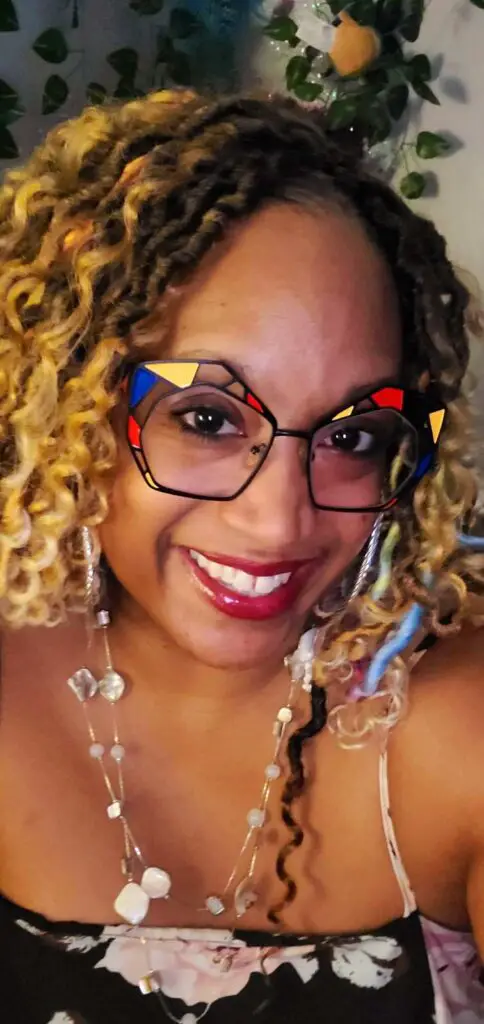
About: With over 21 years of clinical experience specializing in neuroaffirming, decolonized, complex, and developmental trauma treatment and integrated wellness services, Tawanna Marie Woolfolk is a licensed clinical social worker with an MSW from Smith College School of Social Work. Woolfolk is certified as a EMDR therapist, Trauma Professional, and Grief Specialist. She is in private practice where she is also the director/CEO & Doula for the Soul. Tawanna Marie grew up in the foster care system after suffering malnutrition, educational neglect, sexual and physical trauma. Tawanna Marie always intuitively knew who were the right people to steward her through towards resiliency and has committed her life to planting mustard seeds of hope and faith through her clinical work, public speaking, training, education, supervision and consultation.
For someone meeting you for the first time, how would you describe who you are and the work you do?
I describe myself first as someone who pays attention, to people, to systems, and to what the body is quietly communicating when words fall short. I am a Licensed Clinical Social Worker with over twenty years of experience working in medical, mental health, and community settings, and I was trained as a sociologist before becoming a clinician. That sociological lens has never left my work.
I come to this work as an autistic, neurodivergent, multiracial adoptee who is childless by choice, and as someone whose life has been shaped by navigating institutions that often mistake compliance for wellness. The instrument I use to move through this work is not only clinical practice, but art, writing, poetry, performance, story, and embodied expression. I understand art as a way of telling the truth when language alone has been flattened or domesticated.
I am also an advocate and a social critic. I choose not to stand in indifference, prescriptive platitudes, denial, or dissonance. Instead, I stand in the tension—particularly the tension created by systems of caste, hierarchy, and deference that shape whose pain is taken seriously and whose is normalized. I do not deviate from this stance, whether I am working with clients, consulting with professionals, or teaching within institutions.
My work centers people who have had to adapt to unsafe or misattuned environments in order to survive—and who are now living with the cost of those adaptations. Through therapy, teaching, and consultation, I focus on restoring dignity, choice, and relational safety, without pathologizing the strategies that once kept people alive.
I locate myself in a lineage of thinkers and truth-tellers such as Maya Angelou, bell hooks, Nikki Giovanni, and James Baldwin, alongside relational and humanistic voices like Eugene Gendlin, Carl Rogers, and Irvin Yalom. What they share—and what I carry forward—is a refusal to separate healing from truth, or care from accountability.
At its heart, my work is about helping people come back into relationship with themselves, their bodies, and their knowing, without shrinking, and without being asked to disappear in order to belong.
You’ve worked in medical, mental health, and community settings for over twenty years. What has that experience taught you about how people really heal?
What my experience has taught me, again and again—is that people do not heal because they are given the right technique. They heal when they feel safe enough to tell the truth, first to themselves and then in relationship. Healing is less about fixing what is “wrong” and more about restoring what was interrupted: safety, agency, dignity, and connection.
Across medical, mental health, and community settings, I’ve watched people do everything they were told to do and still feel unwell. That’s because many systems are designed to treat symptoms while ignoring context. People are often asked to regulate themselves inside environments that remain fundamentally misattuned, inequitable, or unsafe. Over time, that disconnect takes a toll on the body, the nervous system, and one’s sense of self.
I’ve learned that healing happens when we stop pathologizing survival strategies and start understanding them. Hypervigilance, dissociation, perfectionism, emotional numbing—these are not failures. They are intelligent adaptations to chronic stress, unpredictability, or harm. When those adaptations are met with curiosity rather than correction, people begin to soften. They begin to listen inward again.
Real healing also requires relational accountability. It asks practitioners, institutions, and systems to examine how power, pace, and authority shape care. When the burden of healing is placed entirely on the individual, we miss the larger truth: bodies respond to environments. When environments change—or when someone is finally met with attunement and respect—the body often follows.
What I trust now is this: healing is not something we force or rush. It emerges when people are no longer required to disappear, perform, or prove their worth in order to receive care.
You often say that harm can happen even when people mean well. When did you first begin to notice that in helping systems?
I began to notice this very early in my career—not as a detached observer, but as someone inside the system who was being actively harmed by it. I entered the field bright-eyed and deeply committed, believing behavioral health was a vocation I would live and die in. I believed in the mission. I believed in the ethics. I believed the system would protect both clients and clinicians who were doing the work with integrity.
Instead, I learned, painfully that good intentions do not protect people from structural harm.
I was a Black and brown clinician working in a program that exclusively served Black and brown clients, funded by a grant specifically designed for that population. I was also being supervised by a white woman who did not examine her own bias, jealousy, or positional power. Rather than being protected, I was undermined. Rather than being supported, I was gaslit. I was navigating active discrimination within my workplace while simultaneously being expected to hold profound clinical responsibility for clients who had never worked with a clinician who looked like me.
At the same time, I was being stalked by clients, unsupported by leadership, and given clinical guidance that felt profoundly disconnected from lived reality—formulaic, prescriptive, and devoid of relational pulse. The message I received was contradictory and destabilizing: we want you here, but we will not believe you, back you, or keep you safe. That contradiction is not incidental. It is systemic.
At the time, I did not yet have language for my own neurodivergence—my autism, my ADHD, my nonverbal processing. I did not yet understand how my natural leadership, advocacy, and sensitivity to injustice made me both effective and vulnerable inside rigid hierarchies. What I learned instead was how quickly systems will pathologize or exile those who do not contort themselves to fit unspoken norms of deference and silence.
That experience made something unmistakably clear to me: harm in helping systems is often not the result of malice, but of unexamined power, unchecked bias, and institutional loyalty to comfort over truth. When systems fail to protect clinicians, especially Black, brown, and neurodivergent clinicians, they also fail the communities they claim to serve.
I carry that knowing into my work now. I no longer separate care from accountability, or ethics from power. I pay attention to what happens to both clients and practitioners when survival inside a system requires self-erasure, silence, or betrayal of one’s own knowing.
Many people come into therapy after spending years adapting to unsafe situations. How do you help them understand that those adaptations once helped them survive?
I begin by honoring adaptation as intelligence. I tell people plainly: your nervous system did exactly what it needed to do to keep you alive. Long before you ever arrived in my office, your body was already working—watching, adjusting, bracing, disappearing when necessary. Nothing about that is a failure.
One of the first things I name with clients is that a core part of the work we are doing together is bearing witness. I am not there to police them, fix them, or override their instincts. I am there to offer an honoring, liberating witness to the parts of them that had to evolve in order to survive. And then, slowly, I teach them how to offer that same witnessing stance to themselves.
For many people, this is the first time they have been met without judgment, urgency, or agenda. Most of us were raised under a gaze shaped by attachment conditions, survival rules, and unspoken expectations. We learned to monitor ourselves constantly—anticipating how others might respond, correcting ourselves preemptively, contorting to remain safe or acceptable. In that context, adaptation becomes compulsory, and self-trust erodes.
I intentionally create what I think of as a rebirthing space, one where judge, juror, defender, prosecutor, and victim do not hold power inside the therapeutic container. Those roles can sit outside the room. Inside, the only stance we practice is witnessing. That means slowing down, asking for consent, and approaching one’s own inner experience with neutrality rather than critique. I often model this by asking simple but radical questions: May I witness this with you? May we listen together?
As people learn to witness themselves, they begin to recognize the cost of chronic adaptation. Many of the conditions that bring people into medical and behavioral health systems are not personal failures, but diseases of despair, signals from bodies that have not been seen, believed, or allowed to rest. When people are consistently policed, coerced, or managed through prescriptive platitudes, their interoceptive signals, their inner whispers of yes, no, danger, and safety become distorted or silenced.
A central part of my work is teaching healthy detachment, which is not withdrawal, but clarity. People learn where they begin and end, where their values, consent, and responsibility live, and where another person’s does not. This reduces coercion, decreases susceptibility to external influence, and restores the ability to pause and listen inward. Over time, people become less driven by optics and fear of making the “wrong” decision, and more anchored in their own embodied knowing.
What I want people to understand is that healing does not require erasing survival. It requires witnessing it, honoring what it protected, and then gently expanding what is possible when safety, choice, and self-trust are finally allowed to return.
Your work focuses on trauma that is complex and developmental. How is this different from how trauma is usually talked about?
Trauma is often described as something that happens in a single moment—an identifiable event that can be processed and resolved. That framing overlooks a much more common and insidious reality. Complex and developmental trauma are not primarily about what happened once, but about what happened over time, especially in environments where attunement, protection, and emotional safety were unreliable, conditional, or absent.
In my work, I’m not interested in asking what’s “wrong” with someone. That question doesn’t orient me at all. What I want to understand is what a person had to learn in order to survive,band, importantly, what happened just before self-erasure and self-betrayal became necessary. Those moments are rarely dramatic. They are often quiet, relational, and repeated. They are the points at which a person learns that staying connected, staying safe, or staying visible requires abandoning some part of their own knowing.
I believe we have profoundly underestimated the ingenuity of children. Long before they have language or conscious strategy, children intuitively take on what I think of as a countershape of relief for the systems they are born into. They absorb tension, responsibility, vigilance, or emotional labor in ways that stabilize the family or environment, even when it costs them internally. Many of the patterns we later pathologize—obsessive thinking, separation anxiety, hypercontrol, emotional numbing—are not signs of defect. They are residues of brilliance: solutions the nervous system created in response to chronic uncertainty, misattunement, or unanswered questions.
Complex trauma also includes the good things that never happened—the protection that didn’t come, the curiosity that wasn’t allowed, the “why” that couldn’t be asked. The body and brain do not tolerate blanks well. We are wired to seek meaning and coherence. In systems shaped by hierarchy, caste, and deference, questioning is often punished or discouraged. Over time, this trains people to override their interoceptive and neuroceptive signals in favor of compliance, appearance, or survival. That override becomes embodied.
This is why complex trauma cuts across identity lines in ways that are often misunderstood. While structural racism and oppression absolutely produce trauma, there are also generations of people—particularly those assumed to be closer to power—whose wounds remain invisible because they do not match cultural narratives of marginalization. Many of my white clients, including those in law enforcement and other authority-bound professions, come to realize for the first time that what they’ve been carrying is developmental trauma rooted in emotional suppression, rigidity, and unexamined allegiance to role over self. Until they have language for this, their suffering is often misread—or never named at all.
Understanding trauma as complex and developmental requires us to move beyond symptom management and into contextual truth. What looks like dysfunction is often the residue of brilliance under pressure—the aftermath of adaptation in environments that demanded too much for too long. Healing, then, is not about fixing people. It is about restoring attunement, choice, and the capacity to listen inward again, especially where self-trust was once too costly to maintain.
You describe your approach as neuroaffirming and decolonized. In simple terms, what does that mean for someone working with you?
In simple terms, a neuroaffirming and decolonized approach means I do not treat people as problems to be fixed. I start from the assumption that your nervous system makes sense in the context of your life, your body, and the environments you’ve had to navigate.
At the core of my work is an embodied stance of curiosity, wonder, and awe. I am not wedded to a predetermined agenda or outcome, and I am not anchored in judgment, criticism, or bias. That grounding matters. When care is driven by urgency, performance, or the need to “get somewhere,” people feel it in their bodies. When care is rooted in curiosity and respect, safety becomes possible.
Neuroaffirming care means I respect how your brain and nervous system actually work. I don’t ask you to override sensory needs, force eye contact, move faster than your system allows, or perform regulation for my comfort. We work with your natural rhythms and signals of safety. The goal is not normalization—it’s attunement.
Decolonized care means I pay attention to power. I don’t assume that expertise lives only with me, or that healing requires compliance, silence, or endurance. I question models of care that prioritize productivity, politeness, or emotional restraint over truth and embodiment. We stay attentive to how family systems, institutions, and cultural histories shape what you learned to suppress or carry alone.
Practically, this means our work is consent-based, paced, and relational. You are not rushed or pathologized for your coping strategies. I invite collaboration rather than compliance, and I remain transparent about power, boundaries, and choice. For many people, this is the first time healing does not require them to disappear.
You’re trained in EMDR, grief work, and trauma treatment. How do you decide what kind of support is right for each person?
I’m much less oriented to technique than I am to presence. Any method or strategy I use is always housed within an embodied, relational stance that is bottom-up rather than top-down. What that means in practice is that I do not begin with cognition, interpretation, or fixing. I begin with the body and specifically with interoceptive and neuroceptive data.
I explicitly engage the neuroceptive sensory system, which works in tandem with interoception. If and only if a person’s nervous system registers safety, often outside of conscious awareness can social engagement occur. Social engagement isn’t just connection in theory; it’s the ability to attend a session, to speak, to stay present, to risk authenticity. Without neuroception of safety, no technique matters.
Much of our culture, and much of traditional therapy, privileges top-down approaches that center intellect, insight, and rationality. This mirrors a broader societal hierarchy that overvalues the prefrontal cortex while ignoring the faster, more honest intelligence of the body. Our sensory and emotional systems know first. They communicate upward—through sensation, affect, and the vagus nerve—into the limbic system, and only when enough safety is present does the thinking brain come fully online in a way that is integrative rather than performative.
When we start top-down, we often ask people to override or betray what their bodies already know. That isn’t healing; it’s another form of self-erasure.
No matter what modality I’m using, my presence remains anchored in this bottom-up orientation. I center interoceptive and neuroceptive signals as primary, and cognition as a collaborator rather than a commander. From there, insight lands differently—because it’s emerging from felt safety rather than pressure to comply.
This is how I decide what support is right for someone: not by imposing a technique, but by listening closely to how their system is leading and meeting them there.
As the founder of Doula for the Soul, what kind of care or support do you most want people to experience?
With Doula for the Soul, the care I want people to experience is deeply relational, longitudinal, and attuned to transition. I draw from the lineage and philosophy of midwifery, not as a medical role, but as a way of understanding care as accompaniment through gestation, rupture, and rebirth. Midwives have always known that profound change takes time, context, and presence. Healing is not an event; it is a process.
When someone comes into my work, they are often entering a kind of gestational period—sometimes for the first time in their lives. Many people arrive profoundly disembodied, dissociated, or living in chronic appeasement. On the outside, life may appear functional or even successful. On the inside, vitality has been muted in order to survive. My work helps people recognize that numbness and disconnection are not personal failures, but understandable responses to long-term misattunement, coercion, or pressure.
In that sense, the care I offer is rebirthing work. People are not only grieving what harmed them; they are also separating from systems, roles, relationships, and identities that required them to abandon themselves. That separation can be painful and it is also profoundly life-giving. Like any birth process, it involves uncertainty and vulnerability, but it is guided by the gradual return of agency, sensation, and choice.
This is one reason I offer forms of asynchronous support and communication, even though this aspect of my work has been misunderstood and criticized by colleagues within traditional systems of care. Because it does not conform to standardized, time-bound models, it is often labeled as unorthodox. For me, however, it is an ethical choice rooted in how real transformation unfolds. Gestation, grief, and rebirth do not adhere to clinical calendars, and relational safety is built through continuity, responsiveness, and trust not rigid containment.
Ultimately, the outcomes that matter most to me are not compliance or symptom suppression, but aliveness. People leave this work more embodied, more discerning, and more anchored in their own knowing. They are better able to sense their yes and no, to resist coercion, and to choose lives that do not require constant self-erasure to sustain.
At its core, Doula for the Soul is about restoring life force helping people come back into relationship with themselves and their capacity to feel, imagine, and move forward without abandoning who they are.
You also teach, supervise, and consult with other professionals. What do you notice clinicians struggle with the most when it comes to trauma care?
What I notice most is not a lack of care, skill, or ethical intention. It is the strain of working inside systems that quietly ask clinicians to do harm in the name of order, efficiency, or risk management. Many professionals are deeply committed to helping and are simultaneously caught in structures that reward compliance over reflection and speed over relationship.
I often think about the idea of the banality of harm, how ordinary, well-intentioned people can participate in damaging practices simply by following rules, meeting quotas, or deferring to authority. In trauma care, this shows up when clinicians are pressured to prioritize documentation, productivity, or protocol adherence even when it conflicts with what they know a client actually needs. Ethics, rather than being a living practice, can become weaponized—used to police clinicians’ behavior instead of supporting thoughtful, accountable care.
Another major struggle is how deeply systems of caste and deference operate within the field itself. Many clinicians are navigating hierarchies that mirror the very dynamics their clients are trying to heal from—silencing, gatekeeping, competition, and fear of being judged or reported. Dividing and conquering is common: between modalities, credentials, identities, and theoretical camps. As a result, there is often very little real safety for clinicians to process doubt, complexity, or moral distress with one another.
What I hear consistently—from clinicians across settings, including those in private practice—is a profound sense of isolation. Even when people leave institutions hoping for freedom, they often find themselves on islands, carrying heavy clinical material alone, unsure where it is safe to speak honestly. The same dynamics that bring clients into therapy—appeasement, self-silencing, hypervigilance—are being enacted within the profession itself.
This is why I emphasize relational accountability and collective reflection in my work with professionals. Trauma care cannot be ethical if the people providing it are unsupported, afraid, or cut off from one another. When clinicians are given spaces to slow down, name power, and metabolize what they’re holding—without fear of punishment—they are far less likely to unconsciously reenact harm. Humane care requires humane conditions, for both clients and those who serve them.
Silence and compliance come up often in your work. Why do you think so many people learn to stay quiet even when something doesn’t feel right?
Silence and compliance are not personality traits. They are survival strategies learned in environments where speaking up carried risk. When people learn explicitly or implicitly, that truth leads to punishment, withdrawal, ridicule, or danger, the nervous system adapts. Quiet becomes protection. Compliance becomes safety.
Most of us are trained into silence very early. Families, schools, workplaces, and institutions often reward appeasement and penalize questioning. Over time, people learn to mistrust their own internal signals in favor of external approval. If asking “why” threatens belonging, the body learns to stop asking. That isn’t weakness, it’s intelligence responding to context.
What makes this especially painful is that the body continues to register discomfort even when the voice has gone quiet. Interoceptive cues tightness, dread, numbness, fatigue, are often the only remaining language of truth. When those signals are ignored long enough, people may begin to feel disconnected from themselves, unsure why they are unhappy or unwell, but deeply aware that something is wrong.
Silence is also reinforced by systems of power and deference. People are taught that being “good,” “professional,” or “grateful” means not naming harm, not disrupting the status quo, and not trusting one’s own perception over authority. This dynamic affects clients and clinicians alike. It trains people to endure rather than to discern.
In my work, reclaiming voice doesn’t start with speaking louder. It starts with listening inward. When people are supported in noticing what their bodies are signaling—without judgment or pressure—they begin to rebuild trust in themselves. From there, choice becomes possible. Silence stops being compulsory, and voice becomes something that can be used intentionally rather than desperately.
Healing, for me, is not about teaching people to be louder or more confrontational. It’s about restoring the internal conditions that make discernment, consent, and self-trust possible again—so that when someone does speak, it comes from clarity rather than fear.
You bring your lived experience as a neurodivergent, multiracial adoptee into your work. How does that shape the way you understand safety and belonging?
My lived experience has taught me that safety and belonging are not abstract ideas, they are embodied states. They are felt, or they are not. As a neurodivergent, multiracial adoptee, I learned early that belonging was often conditional, and that safety could disappear the moment I became too visible, too honest, or too different.
Because of that, I understand safety not as something declared by authority, but as something co-created in relationship. I pay close attention to cues—tone, pace, permission, and power—because I know how quickly environments can become unsafe even when no one intends harm. Belonging, for me, is not about fitting in. It is about being able to remain intact while in connection.
What may surprise people is that the most consistent experience of safety and belonging in my life has come through my work with clients. Over more than twenty years in what I consider the greatest vocation I could imagine, my clients have been my proof of concept. Their nervous systems, their knowing and unknowing, their responses to care have taught me more about healing than any model, theory, or manual ever could.
Even early in my training, I noticed that I felt safest in the therapeutic space. There was something profoundly honest about the shared vulnerability—something reciprocal and deeply human. Many of my clients were the first people to meet me without requiring masking, performance, or explanation. They received me with an openness and trust that allowed me, in turn, to become more fully myself.
That experience shaped my understanding of healing as inherently relational and reciprocal. While clients often believe they are receiving something from me, the truth is that I am also a recipient of what unfolds in the work. This is where my theory that healing is the gift that gives comes from—not as sentiment, but as lived experience. When people are met with dignity, curiosity, and consent, healing generates more healing. It moves in both directions.
Safety and belonging, as I understand them now, are not about roles or hierarchy. They arise when people are met without coercion, when difference is not treated as a problem, and when consent is honored as an ongoing process. My clients have been central teachers in that knowing, and their trust continues to shape how I show up—in the room and in the world.
Healing is often framed as something individuals must do alone. What do you think systems and professionals need to take more responsibility for?
Systems and professionals need to take responsibility for the conditions in which healing is expected to occur. Too often, individuals are asked to regulate, recover, and “do the work” inside environments that remain unsafe, inequitable, or fundamentally misattuned. When healing is framed as a private task, systems are relieved of accountability for the harm they produce or sustain.
I often say that there is no healing, learning, equity, or liberation in isolation. Injury happens in context, and healing must be supported in context as well. At a minimum, systems need to take responsibility for pace. Healing cannot be rushed without cost. Productivity metrics, time-limited models, and pressure to demonstrate improvement often replicate the very dynamics that injured people in the first place—urgency, compliance, and self-abandonment.
There also needs to be greater responsibility for power. Professionals and institutions must examine how hierarchy, credentialing, and risk management shape whose voices are believed and whose concerns are dismissed. Ethical care requires more than avoiding wrongdoing; it requires active attention to how policies, practices, and silence can perpetuate harm even when intentions are good.
Systems must also take responsibility for the emotional labor they extract. Clinicians, educators, and caregivers are routinely asked to hold profound suffering without adequate support, supervision, or space to metabolize what they carry. When grief, doubt, and moral distress have nowhere to go, they surface as burnout, rigidity, or withdrawal—none of which serve clients or communities.
Ultimately, healing cannot be an individual obligation when injury has been relational, structural, and sustained. Systems and professionals must invest in conditions that support safety, reflection, and repair—for clients and for those who serve them. Healing becomes possible when responsibility is shared, accountability is relational, and people are no longer asked to carry alone what was never meant to be borne in isolation.
What kinds of people or organizations usually Benefit most from your services and trainings?
The people and organizations who benefit most from my work are those who sense that something about the usual way of doing care, leadership, or healing isn’t working, and who are willing to slow down enough to question it.
Individuals who come to me are often highly capable, deeply caring, and profoundly tired. Many are neurodivergent, multiracial, adopted, or otherwise navigating identities that don’t fit neatly into dominant norms. Others may look “successful” on the outside but feel disconnected, numb, or chronically overwhelmed on the inside. They are often people who have been told they are too sensitive, too intense, or too much, when in reality, they have been carrying more than their share.
Organizations and professional groups who benefit most are those open to examining power, pace, and culture, not just skills or outcomes. This includes healthcare teams, educators, therapists, consultants, leaders, and institutions willing to look honestly at how systems shape behavior. The spaces that thrive in my trainings are those ready to name out loud that something isn’t optimal—and who are willing to do the relational work required to change it.
At its heart, my work as a Doula for the Soul is not confined to one industry or role. I go wherever there are humans, and therefore souls,vwho want to pause, take a breath, and reimagine how care, leadership, and problem-solving could be more life-giving. There is no place I won’t go if there is a genuine desire for liberation, repair, and humane solutions.
One of my core strengths is translation. I help people and systems recognize where meaning has been lost—often at the level of the nervous system—and I translate complexity into shared understanding. I have a way of approaching topics that can feel divisive, inflammatory, or paralyzing and holding them in a manner that equalizes the room. When people feel understood rather than cornered, something shifts. Dialogue becomes possible. Creativity returns. Growth and regeneration can begin.
Ultimately, those who benefit most from my work are not looking for quick fixes. They are looking for integrity, for ways of working and living that honor both the human and the systemic realities at play. When that readiness is present, the work goes deep, and it lasts.
When someone leaves a session, training, or conversation with you, what do you hope they understand more clearly about themselves?
I hope they understand that they are not broken, and that there has always been intelligence in how they survived. I want people to leave with a clearer sense that their responses, patterns, and instincts make sense in context, even if those strategies now need care, rest, or reimagining.
I also hope they understand that they are allowed to trust themselves again. That their body carries information worth listening to. That confusion, hesitation, and grief are not signs of weakness, but signals asking for attention rather than correction. When people can locate their own yes and no with more clarity, their choices begin to feel less fraught and more grounded.
I want people to recognize that they have not been alone in what they’ve been carrying. Much of the shame, exhaustion, and self-doubt people hold privately has never been personal. It has been shaped by systems, relationships, and expectations that asked too much for too long. Naming that can be profoundly relieving—and it allows people to stop blaming themselves for injuries that were never theirs to bear alone.
What I hope stays with someone long after our encounter ends, whether it’s a single conversation or an ongoing body of work, is a felt sense of aliveness. I want people to feel their heartbeat again. To feel that they are somebody. To feel felt.
If someone leaves more embodied, more discerning, and more compassionate toward themselves, if they feel even a small return of vitality, clarity, or inner permission then something meaningful has happened. Feeling alive again is not dramatic or loud. It is quiet, steady, and deeply grounding. And it is often the beginning of everything else.
What are you currently working on, or what feels most alive for you right now?
What feels most alive for me right now is the continued integration of everything I’ve been naming here, bringing my clinical work, teaching, writing, and advocacy into even clearer alignment. I’m deeply interested in how we create spaces, across healthcare, education, and leadership that support embodiment, consent, and relational accountability, rather than asking people to disappear in order to function.
I’m continuing to write and teach about complex and developmental trauma, particularly at the intersections of power, neurodivergence, race, and systems of care. Much of my current work focuses on helping both individuals and professionals reconnect with their own internal signals—learning how to listen again to what the body has been saying all along.
I’m also expanding Doula for the Soul as a container for this work offering trainings, consultation, and conversations that support people and organizations who are ready to slow down, reflect honestly, and do the deeper work of repair and regeneration. What matters most to me is not scale for its own sake, but integrity, ensuring that whatever grows remains rooted in relational care and ethical presence.
At this stage of my life and work, I’m less interested in chasing outcomes and more interested in tending conditions. When the conditions are right, when people feel safe enough to breathe, to question, and to feel change happens naturally. Being in service to that process, wherever it’s needed, is what feels most alive for me now.
Important links
https://www.emdria.org/directory/people/tawanna-woolfolk/
https://www.instagram.com/doulaforthesoulenterprises?igsh=NHRoa2E2bTVjenE3
https://m.youtube.com/@sacredgroundinstitute

We believe in sharing knowledge with everyone and making a positive change in society through our work and contributions. If you are interested in joining us, please check our ‘About’ page for more information