
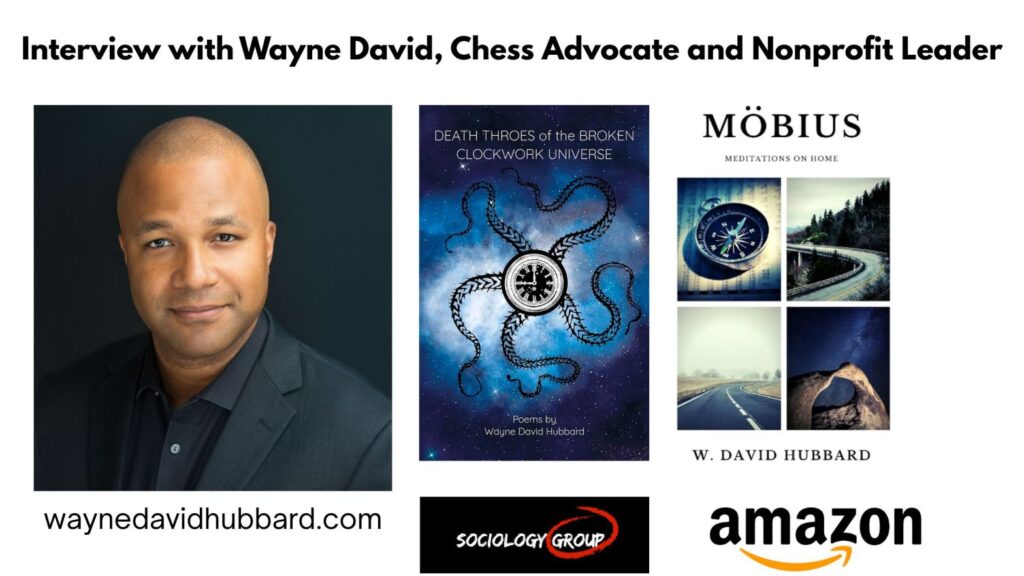
Welcome to our interview series, Wayne. It’s a pleasure to have you with us today. For readers meeting you for the first time, how would you describe yourself in a few words?
I am an author, educator, and polymath. Polymath means I seek mastery in different fields – like art or math – with the purpose of applying new thinking to complex problems. In my everyday life, I am most known for my work in aerospace. I keep people safe when they are in the sky.
You often mention loving three things: writing, airplanes, and chess. When did you realize these weren’t just hobbies, but core parts of your identity?
I fell in love early in life. In my mind, these activities share one common theme: a freedom of movement – intellectually, physically, and spiritually.
My first memory of chess was at age four. Chess felt like a world of infinite possibility. My fascination with flight began as a crippling fear of heights. As a teenager, I sensed the only way to beat this fear was to get close to it. So I pursued training and solo flew an airplane before I was old enough to drive a car.
With writing, it is difficult to pin down a clear beginning. I was an avid reader with a big imagination. The tactile act of touching pen to paper felt easier than speaking.
Today each activity is a vital part of my interactions with the world.
What inspired you to start the Shenandoah Valley Chess Club, and what surprised you most about the response for the community?
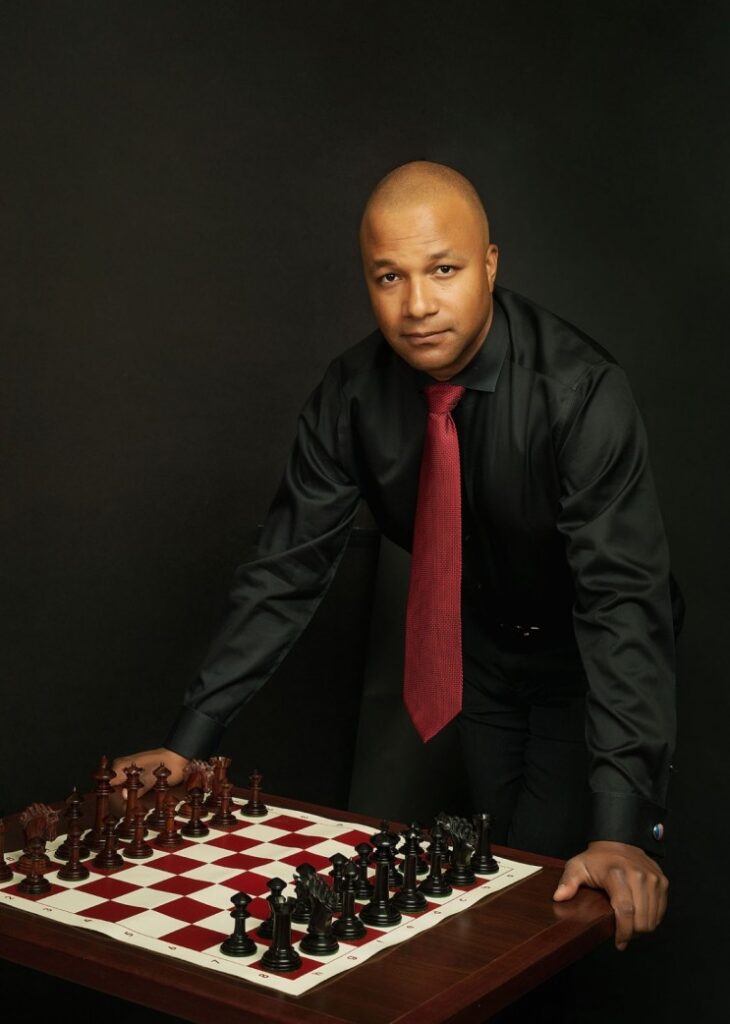
Growing up, I did not have a chess club or a coach. My parents taught me, but I soon defeated them. I continued to learn on my own through books and computers. Fast forward to adulthood, I returned to chess as an online player. One day I connected with some players in person at a local cafe. Someone suggested that we establish a formal club to bring more people together. I decided to go for it.
I lacked a clear plan, but secured some chess sets, negotiated a small space to play, and posted info on the first meeting. We did not even have tables and chairs. But an incredible community stepped forward and contributed the rest.
At the time, I did not know that the chess community consists of the most brilliant, thoughtful, and creative minds you will ever meet. These players vary widely in age, occupation, and culture. Yet they bring something special. The club became a central and celebrated place of connection, camaraderie, and idea exchange around the 64 squares. The game itself is 1,500 years old, yet its popularity is still growing. Millions are playing every day.
We outgrew the small meeting space and moved to The Handley Library (one of the most beautiful libraries in America). That was about 14 years ago. Today the Shenandoah Valley Chess Club is a 501(C)3 nonprofit. We support programs in several cities, and have provided hundreds of meetings, including official tournaments and school programs. The mission is to empower people and inspire lives – one move at a time.
Your work spans poetry, essays, and books. How does your creative process change across these forms?
I see my work (writing and beyond) as the same process yet different expressions. Usually, I am just trying to answer a question. Each answer requires a different path.
I aspired to write novels. Essays come naturally to me. But writing poetry can feel wild, and, often, unpredictable. Words and images surge forward, colliding and combining, oscillating between certainty and chaos. In my mind, its closest equivalent is jazz music. It works, yet difficult to explain why.
Getting back to the creative process, I am learning to balance intuition with principles of flow and design. Think architecturally, speak poetically. The sweet spot between rigor and lyricism is where I seem to be at my best.
If someone is new to your work, which book would you recommend they start with, and why?
I would recommend my first book Mobius: Meditations on Home. The reason is because it began so simple. I was trying to answer a question, “How do you know when you are home?”
At the time, I lived in several countries and many places across America. I had found what I thought as a permanent place of love and security – and lost it. I was trying to find that again. The question of home hit me hard.
As I wrote my answers, the image of the mobius strip came to mind. A mobius is a curved infinity loop. To the eye, it is a very simple design, yet its surfaces conceal astounding mathematical complexity. It is impossible to define where it begins, or where it ends.
The third element was a beloved line of a poem by T. S. Eliot:
We shall not cease from exploration
And the end of all our exploring
Will be to arrive where we started
And know the place for the first time.
A question. An image. A line of poetry. It took a leap of faith and imagination to make connections between these elements. Writing Mobius was an euphoric experience.
How did writing these two books prepare you creatively for your upcoming project American Odyssey?
Writing American Odyssey is the opposite of euphoria. This book takes on questions of identity and war – emotionally challenging topics. I chose an unconventional path which is also technically challenging.
Mobius (my first book) was an organic joy. It resonated with readers because it connected with their own meanings and experiences, which was the purpose.
Death Throes of the Broken Clockwork Universe (my second book) was a true poetry collection. It opened the door to a community of poets and editors. Their generous support helped me look at my writing more critically.
Both experiences were essential for the complexities of American Odyssey. It has taken a long time to finish, yet I know it has been worth the investment.
Did anyone in your family inspire your love for writing. Who influenced your style or creative thinking?
Yes – there are two giants in my personal pantheon of heroes: my grandfather, Richard Moreland, and his life partner, Judy Gurovitz. They both lived in Manhattan for over 50 years. She lived on the East Side, a retired photojournalist for TimeLife magazine. He lived on Central Park West, a retired electrical engineer for the City of New York.
They were not writers at all. They were oil painters. They shared a lively appreciation for world and American culture, history, and music. Over the years we made our way around New York City, to museums and concerts, engaging in deep conversations about art.
They would talk, for example, about the process of capturing sublime detail with a paintbrush or camera lens. They helped me develop confidence as a writer. Above all, they encouraged me to keep going. These are my most cherished memories. They are gone now, yet I still want to do work that would make them proud.
What excites you most about the future of technology and education working together?
One unintended consequence of learning chess through computers as a kid is that I developed an early understanding of AI many decades before it became mainstream.
Today I have background in systems engineering, and I am on a committee with the National Academy of Sciences and Engineering, co-authoring and reviewing papers on AI applications in the aerospace domain.
To best answer this question, I must be clear on definitions. Technology is the use of the mechanical arts and applied sciences. AI is a branch of computer science, and, at present, at the leading edge of technology. Education is knowledge gained by the process of systematic instruction.
These definitions are important. Technology and education are human-driven activities. I believe the story of civilizations is not man versus machine. It is humans versus themselves.
If this makes sense, then I am excited about the future. There are wonderful possibilities. The catch is there are no shortcuts. The process of technology and education must be thoughtfully developed and rigorously tested for it to show lasting value. There are no shortcuts. History shows us this too.
When things feel overwhelming, what keeps you grounded and moving forward?
I listen to music continuously. (Philip Glass is my hero.) If music is not available, I am very happy in silence.
What upcoming projects or events in 2026 are you most excited about?
I travel to Portugal in spring. On my last visit I had a profound experience near the city of Porto, where I stumbled upon the Livraria Lello Foundation.
The Lello Foundation is “a cultural entity devoted to promoting critical thinking, facilitating access to knowledge, and empowering relationships between communities and heritage”.
Its main site is on the outskirts of Porto, along a pilgrimage path where an ancient monastery, a castle, and a modern sculpture meet. It is a serene place designed for the contemplation of current issues affecting global societies. This resonates with me.
Best of all, at the site, there is an abundance of silence. I am most excited to reconnect with it.
Finally, what message would you like to leave with young writers, veterans, and community builders who look up to your journey?
The Rebellion of Sisyphus – this is a poem I wrote one night, thinking about the tragic hero who was condemned to roll rocks uphill for eternity. His crime? He was a trickster who figured out how to be immortal and almost got away with it.
This poem seems to be a favorite of students, fellow poets, and others who encounter it.
The Rebellion of Sisyphus
at first
the stones
would not
speak to me
on my last push
they wept
that i would stay
only those
who chain death
can guess
how i reached
the other side
Discover more about Wayne David’s books and initiatives on Amazon and through his official website.

We believe in sharing knowledge with everyone and making a positive change in society through our work and contributions. If you are interested in joining us, please check our ‘About’ page for more information