
About: Brigitte M. Volltrauer Shipman is a mother of two adult sons, an author, speaker, and a certified Martha Beck Life Coach with a Master’s Degree in Education.
Her journey began over 30 years ago when her son, Joseph, was diagnosed with autism. Like many mothers, she initially experienced heartbreak, fear, and uncertainty about the future. However, guided by her deep love for her son, she navigated these challenges and, along the way, discovered the transformative power of resilience, gratitude, and hope.
Today, Joseph is 33 years old and thriving. Together, they co-authored the book A Mother’s Guide Through Autism, sharing their journey and insights. Through her experiences, Brigitte has come to understand that growth often emerges from life’s most difficult moments, and that joy can still exist even in the face of adversity.
She now shares her knowledge and experiences through her talks, books, and the Mother’s Guide Through Autism podcast. Her mission is to support parents and individuals navigating life’s “tsunamis,” helping them move from heartbreak to healing and from overwhelm to empowerment.
Welcome to our interview series, Brigitte M. Volltrauer Shipman and Joseph D. Shipman
What were the first signs of autism you noticed, and how did the diagnosis process affect your family emotionally?
As an educator I had an idea of what to expect with our son with his developmental milestones to monitor. It was confusing because he was so advanced in all areas except expressive language and social skills. We honestly just thought we had a son who was demonstrating genius level behavior. Joseph could read, but we didn’t figure that out until he was 3 years old of age. The biggest sign that something was off was that he only used echolalia and what we referred to as video talk to communicate. We decided that a pre-school for a few hours a week might help with his social and speech delays. It was at that time that a speech pathologist observed our son and used the term autism to help explain where the deficits were coming from. She was correct. Joseph was diagnosed at the age of 3 and a half. This was the 90s with very little information to help guide us. This is when our autism journey began.
Brigitte, when your journey began, what were your biggest fears and hopes as a mother?
My biggest fear was that Joseph was helpless in our world. That our son would not be able to communicate, make friends, or live independently. It was daunting.
How did the early therapy phase shape your understanding of autism and neurodiversity?
What I remember is how truly behind Joseph was from his peers in all aspects except absorbing facts at a very fast rate. What I noticed was that he was a genius that couldn’t’ relate to our world. At that time I thought that I needed to make every moment a teaching moment to help Joseph be part of a foreign world that he didn’t understand.
Can you share a moment that deeply changed how you viewed autism and parenting?
There are many moments, but here is one that helped me understand that my son was the guy who truly got the meaning of life. I had the honor of being Joseph’s teacher when he was a freshman in high school. I gave the students a journal entry to improve their content writing. What I discovered was that not only was Joseph an excellent writer, but he understood the world much better than his peers. My son was bigger in that moment than I ever knew or gave him credit for. I knew we were going to be okay. I didn’t know how, but I just knew all was well.
You often speak about moving from grief to hope. What helped you make that emotional shift?
It took me years. It wasn’t until I acquired practical life tools from the Martha Beck coaching program and became a life coach. I always had hope, but I didn’t have the level of awareness. What I realized was that hope and how I lived my life was up to me. I began the self-love journey. It really is all about understanding yourself and to truly love who you are as a human being. My daily tool of practicing gratitude is how I live in hope.
How did caregiving impact your mental and physical health, and what kind of support do parents often overlook?
I, like most parents, put everyone and their needs before my own. I wasn’t aware that I was putting all things before my own health and wellness. I thought I was doing what I was supposed to do. I gradually began to have autoimmune illness in my 30s and still didn’t shift how I lived my life. The message here is that you must care for yourself first so that you can care for your loved ones. This is a very difficult shift for most of us. This sounds simple, but it takes work to live with true self-love practices. I have shifted my life by taking one tiny step at a time and then recognizing how I am feeling each day. Your body speaks if you listen to it. It is amazing how loud our bodies can scream and how we can justify each ache and pain. I know because I did it for several decades. The truth is you must care for yourself first.
Your book emphasizes self-compassion and gratitude. Why are these values important for families?
I think that we often hear or read about gratitude and self-compassion, but it can often feel like a big concept depending on what space you are living in. I have lived a life without self-compassion and gratitude, and it is a daunting way to live. Once I began slowly moving into gratitude, I began shifting my whole way of life. Rather than laying in bed and not wanting to begin my day, I shifted before my feet hit the floor. Gratitude leads to possibility. I do believe now that anything is possible. I also believe that I am worthy of those possibilities. When I shifted how I lived, it shifted my whole family dynamic. It brings me great joy to see how both of my sons live with this belief, as well. Parents lead the family dynamics. If you don’t like how your family dynamic is working, then YOU must change first.
What are the most common mistakes families make when first seeking autism-related support?
I know from experience, the first thing you want when you hear the diagnosis are answers to help your child. We all do it. I know that it is so overwhelming to navigate which doctors, therapists, schools, family, who to tell, all the while feeling lonely and broken. Grief is part of the journey whether anyone is aware of it or not. I feel that the first piece of support for parents is to have support for themselves. That is the very first step. It seems through my experience that this is often the last step when parents are looking for support. That is the reason I wrote this book. I had so many discussions of how I could reach as many parents as possible to have a guide to offer support. The intention I have is to walk through the journey together–here is what I learned and here is what I am hoping you will take away for your individual journey. Support is essential and your grief is essential. Take a breath and know you will be okay with not being okay.
You describe life challenges as “tsunamis.” How can parents build resilience and respond with kindness?
A life tsunami is a life event that changes our current life circumstances in an instant. I have experienced more than one such tsunami in my life, which has brought me to be who I am today. When you choose to learn from any life event, especially the difficult ones, you will build resilience. Resilience is a gift–an opportunity to grow as a human. So, when you get hit with a life tsunami, choose to move forward one tiny step at a time with the intention to rebuild and become stronger, wiser, and better equipped for the next life tsunami.
Joseph, what does it mean to experience autism from your perspective?
Largely, my experiences living with autism are colored by wanting the same connections and relationships most people want, but without the neurological toolbox most people receive. There are also some things neurotypical people do that I can’t wrap my mind around, whether it’s a disconnect or even a disagreement on my part. It’s like being put into a game you haven’t played before, where very few people can (or will) explain the rules to you, and some rules you can’t seem to make sense of, no matter how hard you try.
What challenges did you face in school, and what changes would you like to see in the education system?
Fortunately, I was able to make it through primary and secondary public education with relatively little struggle because of my mother’s tenacious advocacy and connections as a former elementary school teacher. Most of my struggles in school were of a more subtle, social nature – being bullied and not realizing it, being taken advantage of because of perceived (and real) naivety, etcetera. As far as changes to the education system go, I would like to generally see more neurodivergent/special needs students have meaningful access to accommodations, similar to myself. I also think much of what needs to change about education for disabled people heavily overlaps with what needs to change for so many other groups on a fundamental level.
How do you manage social situations and missed cues that others may take for granted?
For me, social skills are much more directly an acquired skill, like how driving is a skill one has to engage with intellectually on some level. While my social skills now are more or less on par with neurotypical people, it’s still an activity I have to engage with consciously to some extent. This takes energy, which while plentiful for me, is finite and requires recovery time. If I think I missed a cue, I have a tendency to directly address/correct it. I also have a tendency to ruminate and experience anxiety over the potential consequences of being judged for my social faux pas. This has caused me to develop a habit of overexplaining things as a way to attempt getting ahead of any potential misunderstandings. However, I am fortunate enough to have learned ways to manage and address my anxiety as a byproduct of my spiritual studies during my teens and 20’s.
What social stigmas around autism affect you most, and how can society help break them?
I think, these days, I’m mostly affected by the sorts of stigmas that lead to me being condescended/talked down to. For example, a person might feel mildly annoyed by my behavior, find out I’m on the spectrum, and all of the sudden, I’m being talked to as though I’m 5 years old. It implies I’m still being seen as a lesser sort of person, but they overcompensate on kind words/gestures out of guilt for their prejudice. Unfortunately. This is rather common for most kinds of prejudice and/or bigotry, especially ableism. I also think my experiences with stigmas are mild compared to people with more severe symptoms of autism, and people on the spectrum with overlapping stigmas/prejudice, such as non-white and LGBT+ autistic people. If we hope to break the stigmas associated with autism, we also have to be willing to break the plethora of stigmas that govern our society. The first step to that is to make people aware of them. Most people who believe in stigmas aren’t even aware that they believe in them, much less that they’re stigmas, and MUCH much less how pervasive and deeply rooted these beliefs are. We can’t hope to break stigmas if we aren’t even aware of them, not to mention willing and able to examine, critique, and change them.
What has your experience been like in work or public spaces, and how can institutions become more inclusive?
My experiences with work have been relatively good, although I struggled with certain aspects of learning/surviving workplace politics like many on the spectrum do. Public spaces, like the grocery store or the DMV, are usually no trouble for me. Still, I acknowledge this is due to my fortunate circumstances as a child, and my ability to tolerate certain stimuli and masks, which is not universal among autistic people. While actions by some businesses and institutions have the right sentiment, such as sensory-friendly time slots or days, true inclusion can’t only be one for one day or for several hours a month. True inclusion is permanent, fundamental, and pervasive.
Why do you believe being different is a strength rather than a limitation?
I think for me it’s because being different has given me perspectives on topics many don’t/won’t consider. It has also done a good job at keeping me grounded – to not get caught up in my own hype, as it were. It also helps me understand limitations in some things should never be conflated with limitations of general ability, much less fundamental worth or value.
How has working together as a mother and son influenced your relationship?
Joseph answer: I feel like us working together is part of the logical evolution of the relationship we’ve always had. If anything, I had to learn how to work in the new dynamic we have as full grown adults. I will always be her child, but I had to remember I haven’t been a literal child for a while.
How important was community support in your journey, and how can families build stronger support networks?
Joseph answer: Humans literally cannot survive without each other. Community will always be vital to us, and I think one of our biggest social problems (at least in the US) is an imbalanced belief in “rugged individualism”. I’ve seen too many people needlessly struggle because of the belief that they should be able to take care of themselves with little to no help from anyone. If we want to build stronger support networks, we have to build community again. Real community, with diversity, inclusion, interconnectedness, built with collective power and for collective benefit.
What daily habits or practical strategies helped your family manage stress and communication?
Joseph answer: My worldview is profoundly influenced by Buddhist teachings and practices, so reminding myself of the truth in these things helps. I also have taken to writing things down, especially lately. Also, my partner is neurodivergent like myself, and we like low, warm lighting. It helps lower our anxiety and electric bill.
What policy or social changes are most urgently needed to improve the lives of autistic individuals?
Joseph answer: I don’t believe one can advocate for social, political, and/or economic change for one group and not others. Intersectionality is true, and we are all being affected by the consequences of contradictions in our society that haven’t been properly addressed. Frankly, the most urgently needed changes are the ones we all need. I also believe these changes need to be fundamental, progressive, and democratic.
What is your long-term vision for the neurodiversity movement and autism advocacy?
Joseph answer: I hope for a future where autism is an accepted part of the human condition, whose varying disabilities are accommodated for, if not cured (for lack of a better word). I also hope all actions taken towards these ends are done with the input and acceptance of neurodivergent people, themselves.
“Nothing about us, without us.”
Finally, what message of hope would you like to share with parents, educators, and neurodivergent individuals worldwide?
Joseph answer: A better world is possible, but we have to make it. After all, if we stick together they can’t beat all of us.
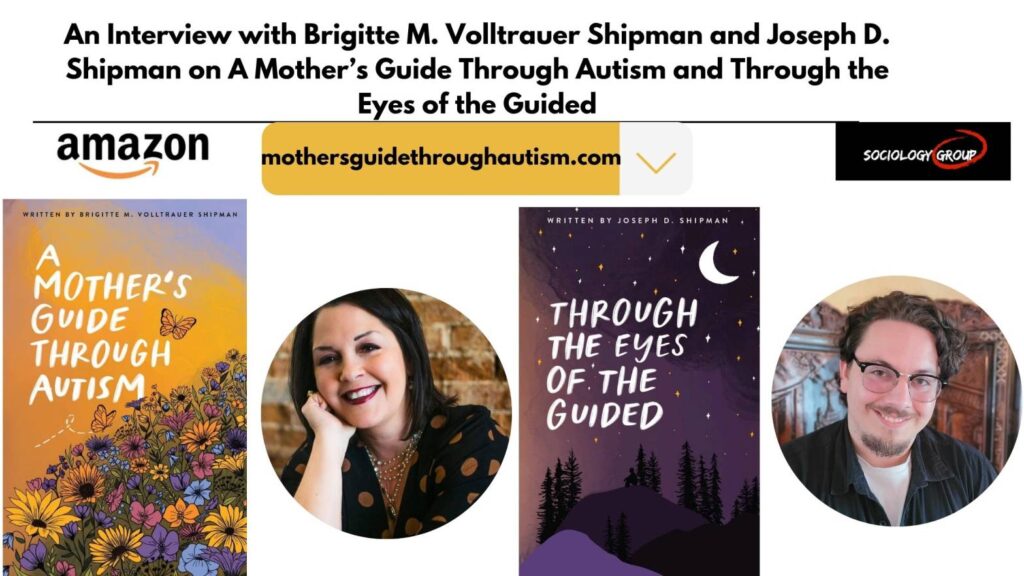
Check out A Mother’s Guide Through Autism and Through the Eyes of the Guided by Brigitte M. Volltrauer Shipman and Joseph D. Shipman, a powerful mother–son perspective on autism. These books offer heartfelt experiences, practical guidance, and honest insights into navigating life with neurodiversity. Available now on Amazon, an inspiring read for parents, educators, and anyone seeking deeper understanding.

We believe in sharing knowledge with everyone and making a positive change in society through our work and contributions. If you are interested in joining us, please check our ‘About’ page for more information