
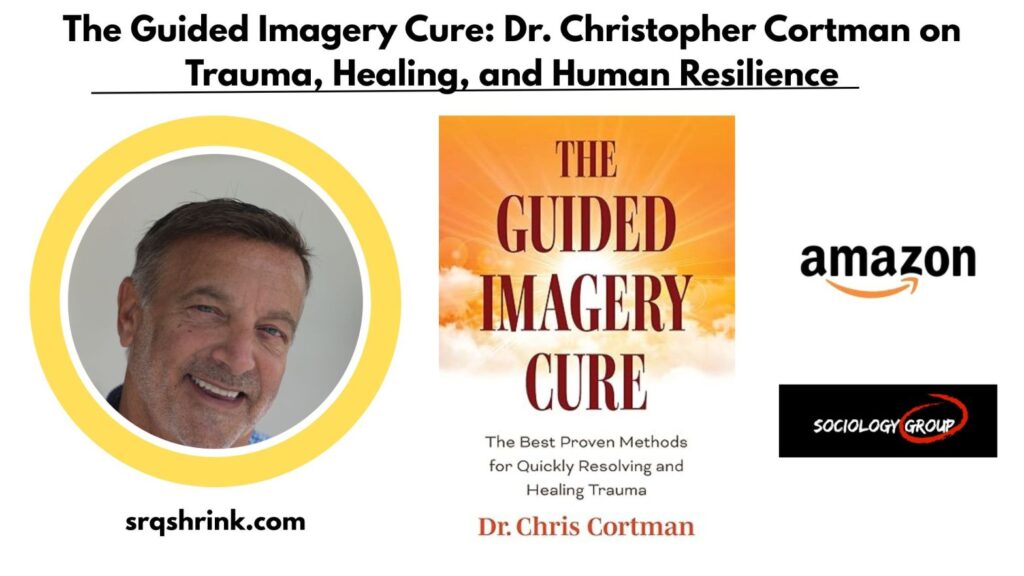
BIO: Dr. Christopher Cortman has facilitated over 80,000 hours of psychotherapy during his distinguished career spanning forty years. A Florida licensed psychologist, he maintains a thriving private practice while specializing in emotional trauma and anxiety disorders. He’s appeared nationwide on talk radio and television. The acclaimed author of five previous books, his new book, The Guided Imagery Cure: The Best Proven Methods for Quickly Resolving and Healing Trauma, describes a profoundly impactful tool for addressing trauma, grief, and more. Learn more at srqshrink.com.
Before we get into your work and ideas, after 40 years and more than 80,000 hours of psychotherapy, how are you feeling at this stage of your journey, both professionally and personally?
Honestly, I’m delighted. Reaching 40 years post-licensure and somewhere around 85,000 hours of psychotherapy is a milestone I don’t take for granted. But I have no intention of retiring anytime soon, because I feel like there’s so much more work to do.
For instance, I’ve developed a wellness and prevention program called The Social Black Belt, which teaches ten psychological truths and has been shown through research in local schools to be effective. The concept comes from the martial arts: someone with a black belt has reached the highest level of training, and while they don’t go looking for trouble, they can handle whatever comes their way. When I work with high school freshmen, that means helping them navigate bullying, peer pressure, expressing their beliefs appropriately, public speaking, meeting strangers, and understanding their own skills and tendencies. It also means teaching them concepts that took me decades to fully appreciate clinically: the meaning behind behavior, why we do what we do, where our emotions come from and what they’re telling us, how we sabotage ourselves, how all human behavior requires permission from the self, and how to differentiate our own sense of self from other people’s opinions of us.
It’s my fantasy to teach the Social Black Belt to as many people as possible. I’m also working on my next book, on the seven secrets of wellness and longevity, along with a few other concepts I’m eager to share. So to sum it up: after 40 years, I don’t feel finished. I feel like I’m just getting started on the things that matter most to me.
Looking back across thousands of sessions and human stories, what feels like your deepest accomplishment — something that goes beyond titles, books, or years of experience?
Looking back, my deepest professional accomplishment centers on a particular group of patients I treated, primarily in the 1990s. I was both blessed and challenged by an influx of patients, almost all women, who showed symptoms of what was then called multiple personality disorder and is now known as dissociative identity disorder. These were women who had survived horrific childhood trauma, including physical, emotional, sexual, and ritual abuse, and had managed to survive by fragmenting their traumatic memories into separate alter personalities.
Through years of treatment, by sharing their memories one painful piece at a time, and through sheer faithful perseverance, these women healed and ultimately integrated back into a single, whole person. This happened no fewer than seventeen times in my career. I have one DID patient in my practice right now who will become number eighteen, because she has that same courage and persistence.
These patients carried more severe pain and trauma than almost anyone I’ve encountered professionally, and they found a way to heal anyway. What still moves me is that several of them have returned to see me years later for entirely unrelated reasons, and when I ask about the abuse that once defined their lives, they’ll say something like, “We finished that years ago. Right now I just need some support dealing with my husband’s medical issues.” That shift, from a life organized around surviving trauma to a life with ordinary, everyday concerns, tells me the healing held.
Helping people carry that kind of pain across the finish line and become whole is the greatest source of pride and satisfaction in my career.
While reading The Guided Imagery Cure, one thought kept coming back: you challenge the idea that “time heals all wounds.” Was there a particular patient or moment in your career where you thought, we may have misunderstood healing itself?
There wasn’t one particular patient so much as a recurring pattern across many. People would wait until they felt safe enough to trust me, and only then would they bring me back to unfinished trauma in their lives, most often childhood sexual abuse. I also had a contract with the VA at one point, and they would refer Vietnam veterans to my clinic. Working with them taught me something similar: there were aspects of their military experience that were never simply going to fade with time. But if we returned to the scene, so to speak, we could help them heal.
What I learned from all of this is that it was never time that healed. It was the courage to remember, feel, express, release, and reframe. I developed that five-step formula directly from what my patients showed me, and I named it the FRITZ, in tribute to the great Fritz Perls
One line from the book really stood out: “The mind is like the stomach — whatever remains undigested may repeat on you.” What made you describe emotional pain in that way?
That comparison came from simply observing how the symptoms of post-traumatic stress disorder work. Flashbacks, nightmares, intrusive recollections — all of these are the mind’s way of trying to push undigested material back to the surface so it can finally be processed and finished. It reminded me of how undigested food can wreak havoc on the body, but once it’s been properly digested, it no longer causes harm. The same thing seems to hold true psychologically. Painful events that are simply pushed away and never processed retain their power to make us sick. It’s only once they’ve been fully “digested” — remembered, felt, and released — that they lose their grip on us.
Reading the stories of Stafford and Todd in The Guided Imagery Cure, I kept wondering: when people finally revisit a painful memory differently, what changes first — the memory itself, the emotion attached to it, or the meaning they give it?
It’s not so much that we’re trying to change the memory itself — the facts of what happened remain the facts. What we’re working to heal is the meaning and the emotion attached to that memory. In Todd’s case, the man he struck while riding his bicycle did not come back to life. Nothing in the imagery work changes that reality. What we were aiming for instead was peace, closure, and some sense of hope for Todd, so that he wouldn’t remain trapped in a pocket of devastation, despair, and hopelessness.
That’s really the heart of what guided imagery is designed to do: help the patient process what happened in a way that allows them to move forward with hope, rather than staying frozen in the worst moment of the story.
Another interesting point from The Guided Imagery Cure is that our nervous system can respond to imagined experiences as if they are real. When you first began seeing this happen in your own practice, what was your reaction?
Honestly, my first reaction was delight. I realized there was real potential here to help people transform long-standing trauma, not by pretending it didn’t happen, but by facing what happened and then adding something new to the story that helped it feel resolved. For instance, I worked with a woman who used guided imagery to confront the man who had abused her as a child. He had long since passed away in real life, but in the imagery, she finally had the chance to say everything she had always wanted to say to him. The goal was to take away the power he had held over her life for so long — and watching that happen in real time was remarkable.
While reading the book, I noticed that many people seem to carry guilt even when something wasn’t truly their fault. Why do humans sometimes blame themselves rather than accept that life can be painful and unpredictable?
What a wonderful question. I’ll answer it through a patient I wrote about, a father who lost his son to a drug overdose. For two years, he carried tremendous guilt, believing there was something he could have or should have done to prevent it. As long as he held onto that guilt, he didn’t have to fully say goodbye. Guilt, in a strange way, felt easier to carry than the grief underneath it.
That changed in a single guided imagery session. In the imagery, he was able to place his son on the other side, at what he called “Rainbow Bridge,” the same place where his two deceased dogs had gone. By picturing his son there, alive and at peace, looking after the dogs, and knowing he would one day be reunited with all of them, he was finally able to accept that his son was truly gone, but not lost. He never needed the guilt again after that one session. I know this because I continued seeing him for a couple of years afterward to work through other issues, and it never resurfaced.
I’ve seen this same pattern play out with other patients over the years: people who go out of their way to blame themselves for the death of a spouse, a child, or someone else they love, because blaming themselves feels more bearable than fully accepting that the person is gone.
In your work today, what is the most common emotional struggle people are bringing into therapy? Has that changed over the years?
I don’t believe the core issues bringing people into therapy have changed all that dramatically over the years. There’s research suggesting that roughly one out of every two therapy sessions has something to do with relationships. People come in because of painful relationship breakups, divorces, challenging dynamics with their children, or difficulty navigating relationships with their own aging parents. That has remained fairly constant throughout my career.
What has changed is who’s willing to walk through the door. Because therapy is far more widespread and accepted now than it was decades ago, I see many more men presenting for treatment, and many more people in general willing to openly talk about stress, anxiety, and depression. There’s also far greater awareness of PTSD than there used to be. The world has always been a stressful place for human beings to survive and thrive in, but more people today are willing to ask for help than ever before — and that shift itself feels like real progress.
We live in a world of constant pressure, comparison, information overload, and always being connected. Do you think modern life is creating emotionally exhausted people?
Yes, I do. I think the social media experiment has already produced enough evidence to draw some real conclusions, and one of them is that these platforms are often deeply toxic, especially for young people. The world of constant pressure and comparison you’re describing makes it nearly impossible for most young people to feel genuinely good about themselves, because there’s always someone out there who appears prettier, more successful, wealthier, or more followed than they are. It’s a comparison trap with no natural floor, and I think it’s taking a real toll.
Looking specifically at today’s generation, what concerns you most about the emotional challenges young people are facing?
What concerns me most is that young people today aren’t being given the actual skills they need — the kind of thing I try to teach through the Social Black Belt. Instead, they’re inundated with unrealistic images, goals, and expectations of what their lives are supposed to look like.
There’s an old Styx song, “The Grand Illusion,” that captured this perfectly decades ago: the idea that if you think your life is falling apart because your neighbor seems to have it all figured out, remember it’s largely an illusion, and underneath it all, we’re not so different from one another. That sentiment was true when the song came out, and it’s even more relevant now. Television, advertisements, and commercials have long been designed to manipulate us into buying products by convincing us those products would make us wealthier, happier, more attractive, or more successful. It was a kind of lie that fed our need to purchase things in order to feel good about ourselves.
That problem is worse today, not better, because now the pressure comes from every direction at once: social media, advertising, peer comparison — all of it simultaneously. As a result, the vast majority of young people feel inadequate, and they’re carrying that feeling almost constantly.
Many people still hesitate to seek therapy because they feel it means something is wrong with them. What are some of the biggest myths people still carry about therapy?
Some of the biggest myths people still carry are that therapy is only for those who are mentally ill, or that needing therapy means you’re mentally weak or incapable of handling your own life. Some men in particular see it as emasculating to share issues — whether that’s panic attacks or erectile dysfunction — with a complete stranger, as if doing so is an admission of weakness.
Having said all that, I’ve seen steady, consistent progress over the 40 years I’ve been in practice. Most people today don’t carry those old assumptions, and they’re far more willing to consider calling a psychologist the same way they’d call a plumber or an orthopedic surgeon when there’s a genuine need. I recall a research study, probably a quarter century old at this point, that found 42% of people would see a psychologist at least once in their lifetime. I suspect that number is considerably higher today.
For someone discovering your work for the first time, could you tell us a little bit about the approaches and therapy services you provide, and what people generally come to you for?
My therapeutic approach is clear and consistent. Most people come to me carrying something they haven’t yet made peace with, whether that’s rooted in their past, present, or future.
A past issue might look like someone who had an abortion years ago and has now reached a point in life where they know they’ll never have children, and they need to reconcile that. A present issue might be a painful estrangement from an adult child over what seems, to an outside observer, like a fairly trivial matter. A future-oriented issue might be feeling jobless and directionless, caught in a pattern of failed relationships, or simply wanting to understand a behavioral pattern, like chronic avoidance, that keeps repeating itself.
My mission with every patient is to help them get to the bottom of whatever remains unresolved and finally champion it — to cross that finish line. Sometimes that requires changing how they see the world. Sometimes it requires changing their behavior. And sometimes it requires accepting that they have no power to change what someone else has chosen to do — a partner who left for someone else, a family that fractured, a parent who cut off contact entirely.
What stays consistent across all of my work is this pursuit of resolution and acceptance, particularly acceptance of the things that are genuinely outside of someone’s control. That even extends to death itself: making peace with the fact that we have no control over what happens next, which requires a real degree of acceptance, and sometimes the willingness to consider that there may be something more on the other side.
Without revealing identities, has there been a patient story that stayed with you because it unexpectedly changed your own understanding of healing?
Absolutely. Possibly the most fascinating patient I ever worked with was my very first dissociative identity disorder patient. She taught me just how deeply connected the mind and body truly are, and how trauma that’s never been processed can manifest itself in startling physical realities.
One story in particular stands out. She arrived for an appointment with a visibly protruding abdomen, looking roughly seven months pregnant, when just two days earlier she had been five foot two, one hundred pounds, with absolutely no signs of pseudocyesis, or false pregnancy. In between those two appointments, she had begun processing a memory of having been impregnated as a child within a ritualistic abuse context she’d been exposed to. She arrived wearing maternity clothing and carrying Polaroid photos of herself with her belly. I knew immediately that something significant was unfolding, so I asked who could help me understand what was happening. One of her other personalities answered and offered to walk me through the story. She proceeded to reenact, in vivid and painful detail, the delivery of a stillborn child. The memories she shared were ugly and devastating, and she cried as she carried the story through to its end. I asked her to write a letter and name the child she had lost. When she returned the following week, she had a visible sense of peace about her, and her abdomen had returned to normal. It never swelled like that again.
I have other stories from this same patient that are just as remarkable. What she taught me, again and again, was that by bravely facing the horrors of her past, she could find genuine healing in the present, and carry real hope and faith into her future. She was my very first DID patient, and also the first to complete the work and become whole — one integrated person.
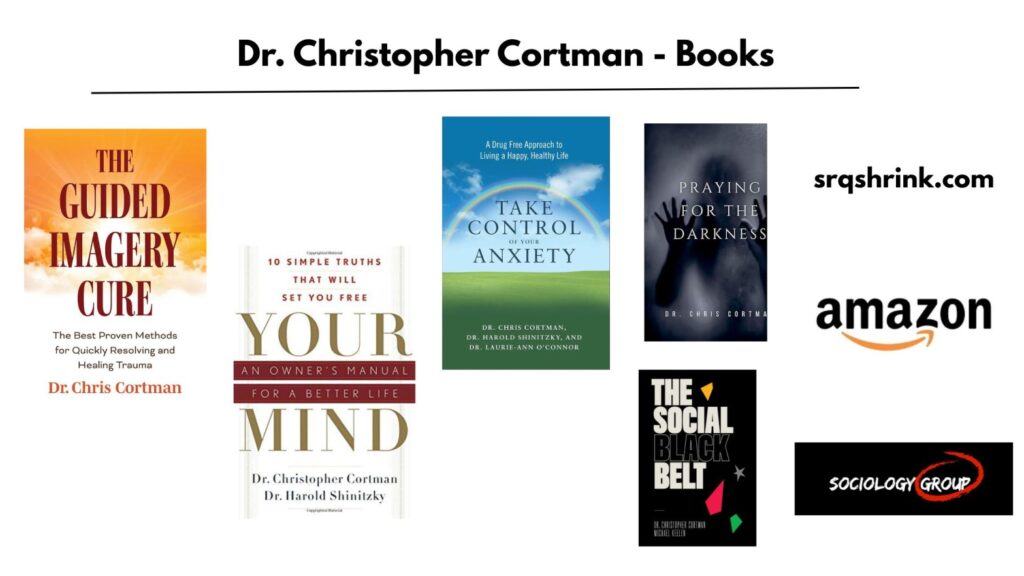
Before The Guided Imagery Cure, your books — Take Control of Your Anxiety, Keep Pain in the Past, and other works — focused on emotional well-being. Looking back now, do you feel your understanding of healing has evolved over the years?
I began practicing psychotherapy in the 1980s, influenced early on by CBT, Carl Rogers, and Gestalt therapy, alongside the Freudian foundations we all learned in graduate school. But as I mentioned earlier, the people who truly taught me the most about healing were the dissociative identity disorder patients I encountered in the 1990s. They demonstrated to me, beyond any doubt, that no matter what someone has been through, if they’re brave enough to face their own story, they can emerge victorious on the other side.
I haven’t seen as many DID patients over the last twenty years or so as I did earlier in my career, but that understanding has only solidified over time. I still operate from the same core principle: people will eventually bring me to whatever is upsetting them, and whatever is upsetting them is upsetting precisely because it hasn’t yet been accepted, processed, finished, or “digested” — whatever word you want to use. My job is to help them accept it, forgive what needs forgiving, make peace with it, and release it, so that it loses its power to control them going forward.
So to answer your question directly: it’s less that my understanding evolved into something new, and more that it’s been reinforced and refined over decades — and guided imagery became the technique that allowed me to put that understanding into practice more effectively than ever before.
As someone who has spent decades studying the human mind, and continuing to write and practice — what future projects or ideas excite you now? Is there still a question about human healing that you want to explore further?
I have to admit, I’m genuinely curious about the role mind-altering medications and psychedelics might play in promoting healing today. Part of me is intrigued by the research. But another part of me honestly believes that deep healing can be achieved without them, because I’ve seen it happen so many times over the past 40 years, through nothing more than the courage to face one’s own story.
I’d also love to see real, measurable data on whether a structured prevention program like the Social Black Belt can help people live genuinely healthier lives and steer away from life-destroying decisions — things like substance abuse, toxic relationships, and harmful choices around money and relationships in general.
Beyond that, I find myself wondering whether we could build a better society by taking the past 130 years or so of psychological science and combining it thoughtfully with what we’ve learned through faith, faith, religion, and spirituality. I actually intend to write a book on exactly that, tentatively called Yesterday’s Scripture, Today’s Science, exploring how many spiritual principles, long held on faith alone, are now being independently documented and supported by scientific research.
And finally, once I reach 100,000 hours of clinical practice, I want to write something that reflects on everything I’ve learned along the way — especially about the singular importance of the therapeutic relationship itself, the bond between doctor and patient, which I believe remains the single most powerful ingredient in any healing process.

We believe in sharing knowledge with everyone and making a positive change in society through our work and contributions. If you are interested in joining us, please check our ‘About’ page for more information