
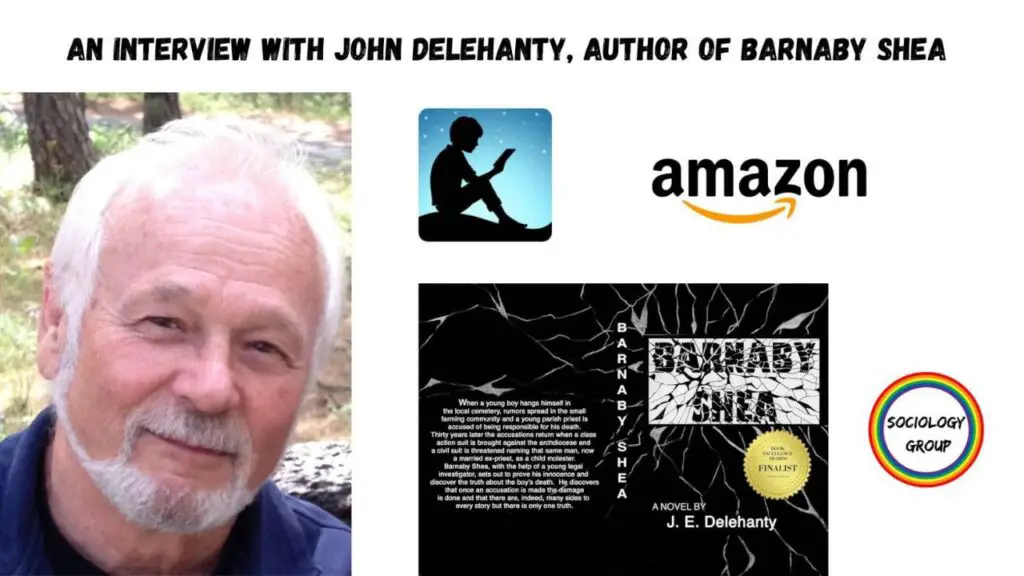
About: Jack is originally from Minnesota but moved to the Northwest with his family when he was young. He completed his undergraduate work at Gonzaga University with a double major in English and Theater, received his MA in Theater Arts from Washington State University and continued his doctoral studies at Northwestern University. An educator for over thirty years, Jack devoted his life to teaching English and Theater to young people. He is an actor, director and devoted supporter of theater on all levels.
Jack’s two novels are the culmination of 20 years of work and although the novels are completely fictitious, they reflect his own roots, his love of family and the gifts they have given him and the beauty of the Irish soul. It is his sincere hope that you love his stories as much as he has loved creating them.
If you were asked to introduce yourself in just three words, beyond “writer” or “author,” what would they be?
Well, that is a difficult one to answer. After all, we see ourselves differently as life goes on and what defines us over the years can change in many different ways. I would have to say that right now, in this very moment, I would love to introduce myself as Husband, Father and Friend. There is no doubt that it is those three roles that influence if not determine every decision, every move, every step in my life. After all, they are, at their core, all about love and don’t we all want to be all about love.
You grew up in Minnesota but later moved to the Northwest. How have those two very different landscapes shaped the way you see and tell stories?
Minnesota shaped my childhood and the Northwest pushed me into adulthood. Which, by the way was, for me, late in coming. I arrived at eighteen still going on fifteen and I am afraid it was only life’s joys and sufferings that finally allowed me to catch up. Perhaps Minnesota colors my stories and my characters more than the Pacific Northwest because it was so profoundly filled with joy. It was a life filled with family, love, adventure, cousins and friends I will never forget. Grandparents who loved and taught, parents who were there in every important moment, an older sister who drove me crazy, first love and first rejection. Of course it was also a time of lessons, disappointments and even tragedy but it had such an impact on me that every story I begin to tell has its roots in Minnesota.
You’ve been an actor, director, teacher, and novelist. which of these roles prepared you the most for storytelling, and which still challenges you?
All four of course. But I think perhaps my career as an educator and what I needed to do to prepare for that role gave me the perspective, the training and the opportunity to be a teller of the written story. The more I engaged my students, the more we discovered about stories together and the more I heard their stories the more the world opened up to me as an author. There is no doubt that writing, being a novelist if I can truly be called that, has been and still is the most challenging role in my life. There is no author I know of, not one that I have talked with and shared with who has found writing easy. Rewarding, yes. Enjoyable, yes. Easy, no. During my acting days I often heard someone say, “If you can find something different to do that makes you happy, do it”. I feel many might say the same thing about writing. If there is something else you feel passionate about you might think about doing it.
Your decades in theater and education must have given you a sharp ear for dialogue. Do you find yourself “hearing” your characters as if they were on stage?
I definitely often measure the credibility, consistency and believability of my character’s dialogue against what I might hear on stage. Theater has given me much to use as a writer; as a story teller. I have been blessed to have been given so many different opportunities to learn and to grow and I believe it has served me well as an author.
When you sit down to write, do you approach it as a director shaping a scene, or as a teacher guiding a lesson or is it something altogether different?
I believe it is a combination of those things but also something different. Creating a story and all that goes into that is very different from telling someone else’s story. A great playwright, for example, gives you everything you need to bring their story to life on the stage but it takes the collaboration of everyone involved; actors, designers and directors to find the way. A novelist, of all writers, has no collaborators. The novelist must do it all.
Barnaby Shea’s voice is distinctive, especially his avoidance of contractions. Why was that choice important for his character, and did it shape the way you heard him in your mind?
Well, I am very glad you noticed that. That single part of Barnaby’s character tells us so much about him, about his world and himself. For example, his avoidance of contractions suggests a respect for our language and our grammar in particular. But it also suggests other parts of who he is. We find out he is not a selfish person. He is a person who gives. What if I had him speak like so many in today’s culture? When people say, “Me and my friend”, it is not only poor grammar it is also incredibly selfish. Always putting yourself first. That would not suggest who Barnaby is. His avoidance of contractions also suggest that he is precise, detailed and clear. Like his music. It definitely shaped how I saw him physically and even emotionally.
You’ve said before that faith and ethics color the way we see the world. How did that worldview influence the creation of Barnaby shea?
Barnaby Shea was originally created in my first novel, ’Tis More than Luck, and was loosely based on a good friend of my father’s. Barnaby is, I suppose, a reflection of my own view of the world. The need for a moral compass and faith in the human spirit. Religion has very little to do with it even for the former priest.
Writing about accusation, shame, and forgiveness is heavy work. How did you carry the emotional weight of this story while writing it?
Having witnessed several good friends struggle and suffer because of accusations. The shame they felt because of guilt by association was difficult to write about but cathartic as well. Forgiveness is at the heart of, and perhaps the most important part of, the human experience. Without it nobody moves forward. I wanted, I suppose, to show through Barnaby that forgiveness is far more important than punishment.
Barnaby Shea begins with a haunting image of a boy hanging from a tree. What was the seed of this story for you, and why did it stay with you long enough to become a novel?
I can’t really answer that question because I don’t actually know myself. I do know that I was not ready to let go of the characters in my first novel. They still talked to me. Especially Barnaby Shea and “Jackie’s” good friend Melvin. I knew it could not end well for Melvin but it took awhile for me to find out why. I was writing about something entirely different when that image came to me and when it did the entire story came to life for me.
Barnaby Shea is an ex-priest, a husband, a lover of classical music, and a man under siege. What makes him the kind of protagonist you wanted to spend years with?
Do you know many people of real integrity, capable of unconditional love, filled with unlimited compassion and capable of real difficult, almost impossible, forgiveness? I don’t. But I wanted to create a character like that and I wanted to place him in a position that tested all of those qualities.
The book wrestles with the destructive power of rumors and accusations. Do you see parallels between Barnaby’s struggle and the way society handles accusations today?
Yes, of course. Perhaps society has always been quick to judge, to generalize, but in today’s world with the help of the media, social media, and a litigious culture many innocent people are the victims of false accusations that the general public has already assumed are true, and many others are forced to suffer the results of wide spread generalization. If several powerful Black men are accused of rape then, for many, it follows that all Black men in positions of power rape. If a pop singer has an affair then all celebrities have affairs. Unfortunately that is how many people think and it causes others to suffer.
Small towns remember everything their silences and whispers often speak louder than words. How did you capture that atmosphere so vividly in your novel?
I grew up in a small town, lived and worked in a small town and currently live in a town that often claims there is no six degree of separation in our town only two degrees. Everyone who lives in a small town knows how damaging those whispers can be and yet they persist. It was not difficult to bring that small town mentality into my story because I have witnessed it personally and profoundly.
John Laney, the disgraced lawyer turned investigator, is such a fascinating figure. Was he always part of the story from the beginning, or did he surprise you by emerging as a key character?
John (or Jackie as he appeared in my first novel) was one of those characters I was not ready to let go. In my first novel he is a young boy just coming of age and struggling to find himself in the new world his parents have taken him into. What happens to us, all of us, as we make that journey into adulthood has always interested me and the second novel gave me the opportunity to explore how “Jackie” became “John”.
Mystery and love intertwine in Barnaby Shea. Do you believe love always deepens a mystery or complicates it?
I believe, I sincerely believe, that love always both deepens and complicates everything in life including a mystery.
If readers were to describe Barnaby Shea in just three words after finishing it, what would you hope they would say?
If they were to describe Barnaby Shea the man, I would hope their three words might include, complicated, forgiving, and loving. If they were to describe the novel Barnaby Shea…well, it would be nice if whatever words they used they would help incite others to buy my novel and enjoy reading it.
You’ve said before that forgiveness is the only way we can move forward. How does Barnaby Shea embody that message, even through its darkest moments?
I believe that in order to forgive we must first believe in the basic goodness in people. It is that underlying belief, whether it comes from one’s faith or simply from witnessing that goodness in one’s own life, it is what allows Barnaby Shea to forgive even when it is extremely difficult. Harder for John Laney perhaps but that is another story.
What do you hope readers will feel when they put down the book anger, empathy, caution, hope?
Whatever they feel, my hope is that they would be moved, touched in some way and that it would give them cause to think about what they have read, the characters they have met, and the choices made. Often an author simply wants to entertain. Their objective is to captivate the reader and take them on a journey of love, or mystery, or intrigue or all three. Their main reason for taking them on the journey is to entertain. Perhaps simply to spin a good yarn. Some hope to include historical fact and so to enlighten as well. My aim is to move the reader. To nudge the reader toward reflection and thoughtfulness that may, in fact, change their own life.
Many readers look for “the why” behind a story. Why did you feel compelled to write this one?
I would have to say that honestly I simply feel compelled to write. The story itself probably comes from many different directions. It might be something like an event or person you meet or something from your past that intrigues or invites or something as simple as a comment made in passing. This particular story has been with me for a long time and was, still is, the result of another’s pain and my need to give voice to that pain. Exactly how that story unfolds I leave to the characters and what pops into my head and on to the page.
You self-published through KDP. What has been the most surprising part of that journey, and how can readers best support authors like you beyond just buying the book?
Thank you for that question. Writing the story is the easy and wonderful part and navigating the publishing world is a difficult nightmare. Whether to publish the traditional way or through an independent press or self-publishing, the author is challenged by an entirely different set of skills. One of the most difficult being endurance. I don’t love marketing and if one is not a best selling author, yet, the cost to have someone do the marketing for you is very, very high and seldom super successful. I would hope that people who love books support their local independent book stores, attend readings and book signings, and, above all, give feed back when they can.
Reviews are lifelines for independent authors. If you could speak directly to a reader who just finished Barnaby Shea, what would you say to encourage them to leave a review?
Like every endeavor in life, we all tend to thrive on positive feedback and we also grow because of constructive criticism. Leaving a review does more than simply sell more books (Although it does do that. There are many, they say, who won’t even look at a title if there are not 50 to 100 reviews). Reviews inspire authors to keep on writing and they also help authors hear about what they should continue to be doing and what may not be working. It answers the question in every author’s mind. Is is worthwhile for me to continue?
You’ve hinted at another novel you’re “daydreaming” about. What excites you most about this new story, and how will it differ from Barnaby Shea?
The story I am currently working on is very different from either of my other works, different characters, different location and a very different mystery. But, I suppose, they are all love stories in a sense. They deal with unconditional love, misguided love, dangerous love and redeeming love. This new idea still deals with a social problem. A problem that is growing exponentially everywhere in our country and in the world. Perhaps love will eventually be the solution.
If you could leave behind one legacy as a teacher, theater artist, or writer what would you hope it is?
Oh boy. Saved the hardest for last did you? I suppose we all leave behind some kind of legacy good or bad, important or not so much. There are only a few things I would hope I am remembered for. Being a good and faithful friend, being a good and loyal husband and father. Those kinds of things. But finally, I hope I will be remembered most for my role as a teacher. I hope that I have given young people a way to know themselves and the world around them better. I hope, in some small way anyway, I have given them a chance to find their way in a world that makes it so difficult to do so. I am pretty normal really, average even, but I hope I excelled as a teacher, as an educator.
Thank You,
J E Delehanty
Check out “BARNABY SHEA” by John Delehanty, a captivating read you won’t want to miss!

We believe in sharing knowledge with everyone and making a positive change in society through our work and contributions. If you are interested in joining us, please check our ‘About’ page for more information