
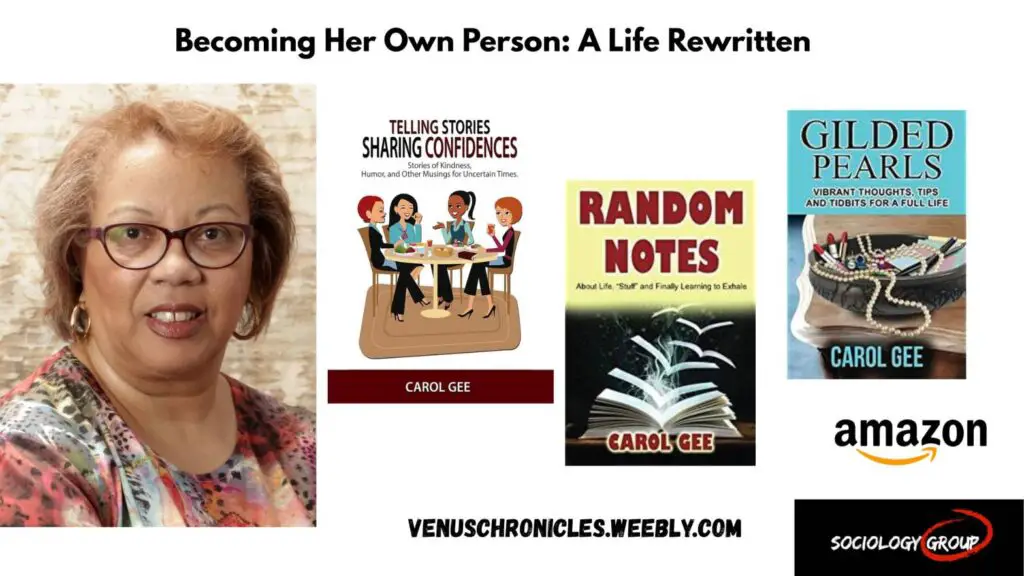
About: Carol Gee is a proud U.S. Air Force veteran who also enjoyed a short stint as a mental health counselor before becoming a longtime educator, including years in both teaching and administration. An author, columnist, and motivational speaker, she encourages girls, women, and men to celebrate and embrace their thoughts, feelings, the silly things they do, in short, their very humanity.
She is the author of Random Notes (About Life, “Stuff” And Finally Learning To Exhale) and Gilded Pearls (Vibrant Thoughts, Tips and Tidbits For A Full Life). Her other books include her debut, The Venus Chronicles, and Diary Of A ‘Flygirl’ Wannabe. Her work has appeared in numerous publications, including Diabetes Forecast, Diabetes Health, Dollar Stretcher Magazine, and Woman’s World Magazine.
Carol and her husband were featured in the February 2017 issue of Essence Magazine in the article “Standing Up For His Health.” The couple, married for 44 years, reside in a suburb of Atlanta, Georgia.
Carol Gee opens up about how humor, lived experience, and perseverance have shaped her writing journey in this engaging interview. For more uplifting stories and reflections, check out her website and read her books.
1. Welcome to our interview series, Carol. Thank you so much for joining us. To begin, could you share a little about yourself and what first sparked your childhood dream of becoming a writer?
CG: I have always loved books. Loved reading. Getting my very first library card at seven years old, one of my fondest memories was of my younger sister, my mother and I, going to the library near our home. Quiet and cool, inside, it was a respite from the cacophony of the District of Columbia noises, as well as the overwhelming heat in our tenement apartment.
Reading everything I could get my hands on from the Bible to various children’s books, I dreamed of someday writing books like those I enjoyed. To jumpstart that dream, I frequently wrote little short stories to entertain my sister. Clearly a savant, she could add numbers in her head, but had problems reading childhood books. So enjoyed my stories.
2. You’ve lived through many chapters, military service, counseling, education, and writing. How did these different paths shape who you are today?
CG: As my books and freelance articles are written about my day to day living, every day, every activity, every conversation, has the potential to be a story. For example, most recently my One Airman story, sharing a bit of my service in the Air Force, was published in my county’s local newspaper over Veteran’s Day.
My short stint as a mental health counselor, I developed a therapy that I called “Faces Therapy”, using various ‘smiley’ faces to help my young patients express their feelings. Lastly, my forty years in higher education at the college/ university level, has led to pieces published in a number of magazines on campus, both in print as well as online. Frequently, the only staff person to be published in some of these.
3. Looking back, how did your time in the U.S. Air Force influence your discipline, voice, or perspective as a writer?
CG: Serving in the U.S. Air Force influenced me in so many ways. Entering at age 20, long before there were many women serving, over the years, I went from a sheltered, frightened young woman into a strong, confident one.
The Air Force, taught me how to manage my time, the importance of following through on projects, and finally gave me the confidence to try various things. All this has helped me to be mindful of deadlines throughout subsequent job positions, as well as in my writing. My ability to anticipate and resolve problems I was successful in subsequent civilian positions. These same qualities have also been beneficial in my writing.
4. You spent nearly two decades in higher education. What lessons from teaching and working with students have stayed with you the most?
CG: While I spent nearly 22 years at Emory University, I worked in higher education as both an adjunct professor and administrator both in the US as well as abroad for a total of 40 years.
First of all, I have truly enjoyed this career. Loved being in a place where learning took place. However, what I have enjoyed most was my interaction with the students. Where frequently described as being ‘tough’ because of my military background, I’ve always wanted to be the teacher or administrator that students felt comfortable approaching for help with class work, resume preparation, even what to wear at a first interview.
Over the years, several of my former work study or research assistants have stayed in touch. Many say that they still use such things as project checklists and other things I taught them. All have been in their careers for years, however, a few still seek my thoughts on professional issues and decisions.
5. You’ve spoken about the “village” of women who imagined you as a teacher before you imagined yourself that way. How did those early expectations influence your journey?
CG: Truthfully, it took me a while to realize where these women were coming from. Although hard workers, some of these women I don’t believe ever finished high school before they had to get a job to support their families. A few may have only been able to read just enough to get by, so the idea of my making a living as a writer was foreign to them.
Whereas, teaching was something they were all familiar with. And a job that was respected back then. While I listened to them, and while being a writer seemed out of reach back then, the dream never left me.
6. Many people set creative dreams aside as life unfolds. What helped you reconnect with writing later in life?
CG: Writing was like a drug that I could not resist. Even as life unfolded, went into different directions, the call of writing was something that I was unable cast aside. Even when I received rejection after rejection.
One such letter still stands out to this day. Where an editor sent back the piece that I had submitted with red ink corrections all over it. Although harsh, it showed my grammatical errors, punctuation issues, and a lot of typos and other issues. Where I could see why it was rejected.
Finally, she added that the piece was not what they typically published. Lessons learned? First, be sure my topic was what the magazine published. Watch grammar, punctuation. Finally spell check, spell check, and spell check!
However, what kept me going was a note author Iyanla Vanzant sent me. At my lowest, I had seen her on TV, seen how approachable she seemed and written, seeking advice. Her reply was “Don’t quit before the miracle.” Over the years this has been my own mantra when writing.
7. The story behind The Venus Chronicles began with humor drawn from everyday experiences. What drew you to using humor as a lens for reflection?
CG: Before joining the Air Force, I worked at the local shoe factory, one of three factories in my small town. Working this dead end job, day in, day out, my life seemed desolate. Picking up the Late Erma Bombeck’s book, “If Life Is A bowl Of Cherries, What Am I Doing In The Pits” someone had left in the factory break room, spoke to me.
Growing up in a slightly dysfunctional household, I’d frequently used humor to self – soothe. In many conversations, I would say something serious, where the other person would say, “Girl you are so funny. You are so crazy.’ Where I would go, “What I’m serious.”
Reading other Bombeck’s books and articles on her, I read one of her articles describing her philosophy, where she believed that “If you can laugh at it, you can live with it. This became my own mantra. The catalyst for my stories.
8. Your writing often embraces the ordinary, the silly, and the human. Why do you think celebrating everyday imperfections matters?
CG: First, I believe it allows people to see that we are all human. That we make mistakes. Frequently do something crazy. One of the joys of my books, which women have fondly coined ‘girlfriend’ books, is women say, they love that I write about many of things they go through, but don’t feel comfortable enough to share.
That my pieces makes them feel least alone. So much so that they say they can’t wait to share with me stuff that happened to them. Things like when they realized that they are wearing two different shoes, same color, but different style, after arriving at work, and other issues. As such, a ‘sisterhood’ of sorts among women has developed. Something that I love.
9. You encourage people to embrace their thoughts and emotions openly. What shaped this philosophy in your life?
CG: Raised by an independent, old fashioned, pious woman, my mother didn’t encourage my expressing my emotions, or thoughts about certain topics growing up. A long time mentor of both men and women during my education tenure, I became close to several whom not only saw me as teacher or administrator of their time cards, but mentor and friend, as such, I encouraged them to share their thoughts, feelings.
Today, I am still considered as a ‘play mom’, second mom, etc., to several former students. Not having anyone to share what I was feeling growing up, I believe everyone should have someone they are comfortable talking over issues with.
10. Having worked briefly as a mental health counselor, how did that experience influence your understanding of storytelling or human expression?
CG: Through the years, I’ve discovered that everyone has a story. A mother once brought her little seven year old girl to see me. A cute brown-eyed brunette, she’d been acting out in both deeds and words.
Turns out, she had a pretty blonde blue-eyed sister that people frequently remarked how cute she was, ignoring my little client. This was when my “Faces Therapy” came about. Using smiling, frowning and other ‘faces’ she demonstrated how that made her feel when people ignored her. More often than not, it was anger that she didn’t know how to express, so did so the only way she knew by acting out.
11. Your books explore life lessons and reflection. What themes or questions were most present in your mind while writing them?
CG:We all do things that is humorous, silly, and causes us to question, “What in the world was I thinking?” As I have gotten older, things that used to mortify me when I was younger, no longer does so. My new motto is “It happened. No one got hurt or died, we live and learn another day.”
12. How has your writing voice evolved from your first book to your most recent releases?
CG: “The Venus Chronicles”, my debut book, what I considered my spoof on the book “Men Are Mars, Women from Venus” tackled fun topics, or some of the things that I had experienced back then.
As other books materialized, my ‘topics’ you might say, became more serious. Thereby, giving myself permission to share topics closer to my heart. For instance, my mother didn’t approve or forbid me to do a lot of stuff when I was growing. She didn’t approve of my sister and I standing in front of the mirror, admiring ourselves.
Looking in it to see if your clothes were okay, that was fine. So, she would have really “hated’ selfies. As such, I rarely take them or other photos. She also didn’t approve of dancing. Once catching me ‘doing the twist.” Saying, that if I was going to dance, I should probably choose a dance like the waltz, one that wouldn’t ‘throw my back out.”
Likewise, she would have hated me even considering pole-dancing (for fun and exercise) as mentioned in my book “Random Notes.” It’s probably why I had considered it.
13. You’ve written for magazines across different audiences and topics. How does writing for publications differ from writing books?
CG: Unlike other freelance writers, I rarely ‘pitch’ a story. At this stage in my life I have given myself permission to write whatever is on my mind at the time. I realized that I would probably generate more money through pitching, having assigned work, etc., but I prefer my way.
If a particular editor can’t use the piece, I will tweak it and submit elsewhere. My goal isn’t always about making money but writing things that resonate with others in some way. This is my same thoughts whether writing my books or magazine articles.
14. Being featured alongside your husband in a health-focused story reflects a deeply personal side of life. How have partnership and shared experiences influenced your perspective?
CG: Married for almost 53 years (Mar 3), my whole life is impacted by our relationship. Our relationship has almost always been about our partnership. I say, ‘almost’ because we had a marital ‘time-out’ at year thirteen.
Where my intensely, quiet husband became even more so. Where he either wouldn’t or couldn’t tell me what was going on with him. I asked. Even the hard questions. This status quo went on for over six months. Until I asked, if he saw whatever was going on, changing and he said. “No.” I chose to ask for a separation.
I write or share this story with others during book events, etc. Our relationship today is stronger than ever, thus, I advise others in similar situations to never settle for less than you deserve. Writing about his health issues as well as my own, my weight issues, diabetes, I hope sharing my emotions, any health hacks (like how to safely store your insulin needles while traveling), can maybe help someone else going through similar issues, is my reason for doing so.
15. After decades of marriage, career changes, and personal reinvention, what does “growth” mean to you now?
CG: “Growth” for me, means I have finally become my own person. That I am no longer held captive by what others think I should do. Think who I should be. Leaving home for the Air Force. Away from a strict upbringing, I did a lot of the things I was forbidden to do. I got my ears pierced. Mother didn’t approve of this when I was growing up.
First, one piercing in each ear. Later, a second piercing in one, and three total, in the other became my own fashion statement. Only later earning that the dorm mate whom pierced the third hole unbeknown to me, was high on LSD, when she used a clothes pen and sewing needle to do so. Good times!
All day Sundays spent in church, later dropped to one service per Sunday. Today, I choose to attend whenever I feel like it. Finally, realizing that I am more ‘spiritual’ than religious. And I am okay with that.
16. Many readers may feel it’s too late to pursue creative dreams. What would you say to someone standing at that crossroads?
CG: Two months short of my fiftieth birthday when “The Venus Chronicles” was published, I tell people that in my opinion, that it is never too late to realize a dream. After all, you hear stories of folks from their 50s to 80s getting degrees, getting professional licenses, jumping out of planes (okay, I’m not recommending that), but you get the idea.
17. What role does humor play in resilience, especially during aging, transition, or uncertainty?
CG: As I mentioned earlier, getting older I believe allows you to stop taking yourself, or life so seriously. Most recently, my husband asked me to get him a soda from the mini fridge in his little man-cave. “The one on the left is the coldest.” He said. “Left, he repeated as I reached for the right.” To which, I remarked, “Oh, you mean my other left.” Where we both laughed as he shook his head, taking my action in stride.
18. When you reflect on your younger self who wanted to write the “great American novel,” what would you tell her today?
CG: To continue striving to write the ‘great American novel.” Subsequently, I pray the book I just finished, “Comfort and Joy (The Songs, Rhythm and Rhymes Of Love an Caregiving), about my husband and I, total opposites in personalities, and despite years twenty years of military life, thirty years of his chronic health issues, we are still together. Still happy. Praying that this story resonates with others dealing with caring for someone they love. And enough see the value of this topic to support it. Thereby, making it a best seller. If not, if it helps someone else going thru the same things, that is good enough for me.
19. What are you most curious to explore next, in writing or in life?
CG: With a bachelors in sociology, a minor in psychology, and a masters in human relations (and management), I continue to be interested in people. You know, what makes them do the things they do.
A ‘people’ person, I frequently talk to strangers in line at the grocery store, bank etc. Sigmund Freud probably had a term for people like me. Most recently, noticing a lady in front of me, wearing a white blouse with an intricate colorful tapestry, I believed it was a MOLA, an embroidery found in Panama, taping her on the shoulder, I asked if it was.
Surprised, I recognized it she answered yes. I shared that my husband and I had lived there for three years while serving in the Air Force. Sharing that I’d loved Panama, the plantains and mangos on trees in my yard, the friendliness of the people etc.
Later, checking out, she shared that she had been experiencing a bit of homesickness. And talking to me about Panama had cheered her up. Having experienced a touch of homesickness over the twenty-one years I’d served in the Air Force, I understood that feeling. A couple months ago, I sold this piece to Woman’s World magazine, where it appeared in their Circle of Kindness section.
So, I hope to continue to write about my day to day life, the humorous as well as the serious and any lessons learned throughout my journey.
20.Finally, what message or feeling do you hope readers carry with them after spending time with your words?
CG: That anything is possible if you want it bad enough. Daily, people come up to me telling me that they have always wanted to write a book about their lives. And, ask me how to go about writing one.
When I tell them that I write something daily. Maybe simply jot down thoughts on subjects I want to write about later. They then ask where I found the time. I shared before retiring, that I often up early before work and wrote a bit. Or wrote on the weekends. That if you really want to write a book, you found time to do so.
I would also advise folks to not be discouraged by those whom don’t understand their dream. (Like the early ‘women in my village’). Also, had I taken all the editors’ rejections to heart (and many times I did), that I wouldn’t be where I am today, with five books and a 6th in the works.
My freelance pieces sharing my thoughts and opinions from A to Z, have appeared or continues to appear in such periodicals as the Atlanta Journal- Constitution, Chicken Soup: Military Families, Coping With Cancer, Diabetes Forecast, First for Women, Romantic Homes Magazine, Woman’s World Magazine, and others. I have also contributed to chapters or anthologies in other authors’ books. In fact, some of the above questions may lead to an article or two someday. After all, everything is my muse. A reporter interviewing me a few years back, described me as a “woman of many words. “Yep, that’s me!”

We believe in sharing knowledge with everyone and making a positive change in society through our work and contributions. If you are interested in joining us, please check our ‘About’ page for more information