
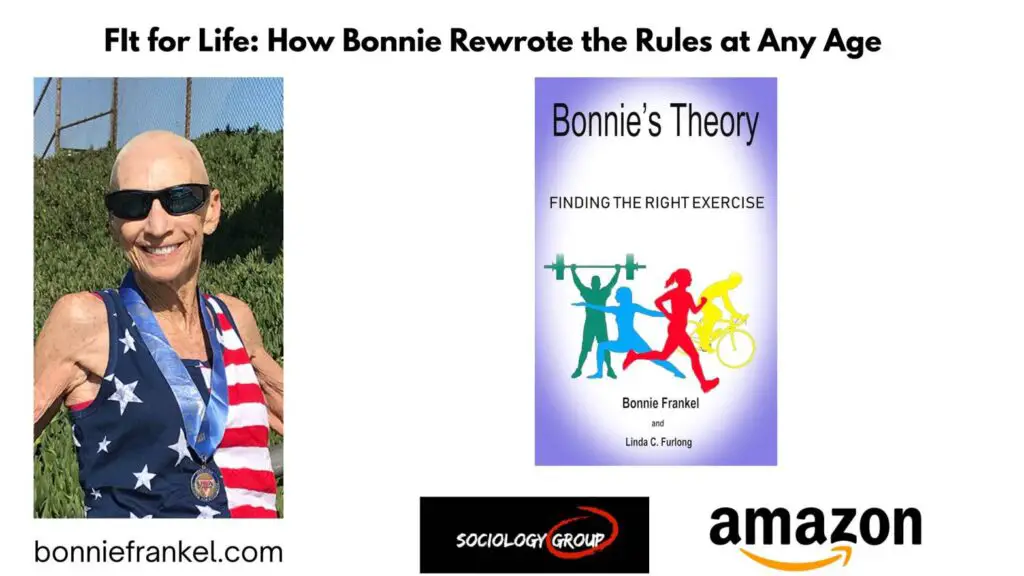
About Bonnie: Several years ago the New York Times began an article about Bonnie Frankel by wishing her a Happy New Year and telling her this could be her decade. USA Today wrote that, if ever there were a movie, “the life and times of Bonnie Frankel” is it. The Los Angeles Times quotes one person after another who said Bonnie showed them how to get totally fit and move into their body’s full potential, like nobody else. They all said they felt more mentally and looked more physically fit than ever, even though they’re getting older. Today, Bonnie focuses on reading, writing and offering her time to folks of all ages. She helps them discover the infinite benefits of daily exercise and general well being.
1.Welcome, Bonnie. Please describe yourself in a few words for our readers.
I am a fit, spunky, fearless and resilient trailblazer who emphasizes exercise to strengthen the use of emotional and social intelligence to create a better me and enkindle an empathetic community.
2. Your life includes profound challenges such as breast cancer, divorce, and mental health struggles.What helped you reclaim control of your life during your darkest moments?
The physical and emotional scares led me to take greater control of my life path. Confronting the fact that life is short allowed me to forge ahead with the evolving me. I accomplished this through combining the skills to embrace healthy daily habits that included exercise, meditation, mindfulness and journaling. My daily engagement with these skills created a powerful and holistic transformation that reduced my stress, improved my emotional regulation and boosted my mental clarity. By including these healthy habits, authorized discontinuing negative thought patterns by encouraging both active release and thoughtful reflection.
3. At age 44, you returned to school and discovered running. What did running give you that nothing else could at that time?
This particular exercise unexpectedly unlatched doors that were closed in the past. It released my pent-up emotions which led to my undiagnosed learning disabilities and opened up the doors to the beginning of what made me tick. Feeling at peace with myself in conjunction with the release of endorphins, it gave me a feeling of power and independence. Running while surrounded by nature assisted me in interpreting the laws, elements, phenomena of the physical world and gave me a sense of connectedness. I felt indestructible and was able to dismantle my emotional and mental barriers through self-compassion, patience, and actionable small steps.
4. Becoming the oldest woman to compete in a Division I collegiate sport is extraordinary. What did that milestone mean to you personally?
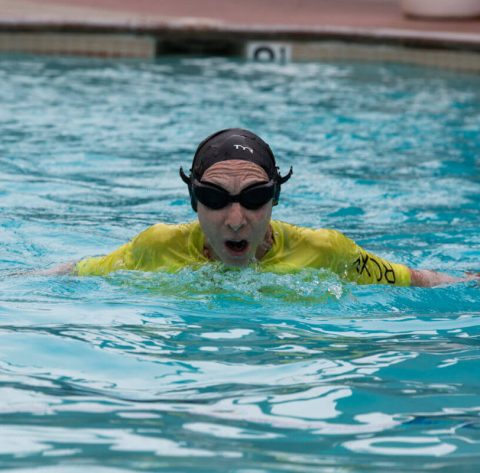
This was a miraculous achievement. What is unique about being the first to inaugurate it was that the competition wasn’t in running, it was in swimming. Most important is that this rule change would benefit other women returning to the educational system to compete in this division. At the same time that I was combating the amendment, I was taking a class called Policy of the Aged, and felt the significance of bonding the younger and older generations through using a competitive sport. Age is just a number and I was still getting acquainted with my own strength to see where that would take me. I felt exalted when the media would compare me to the likes of Billie Jean King.
5. You changed an NCAA ruling now known as “The Bonnie Rule.” Can you explain what this rule is and why it was so important to fight for it?
The rule allowed women who enrolled in college prior to the 1981-82 academic year to compete in Division l sports. This enabled older female student-athletes to resume their education and eligibility, overcoming previous restrictions. Athletics plays an important role in our inner and outer life because it strengthens our use of emotional and social intelligence. This was my way to blend the relationships of the different generations by both understanding and unifying communication.
6. What resistance did you face while challenging the National Collegiate Athletic Association, and how did you stay resilient?
The battle with the NCAA was overwhelming. They told me that this rule had been challenged many times,and that it was futile for me to try to change it because it couldn’t be done. This inspired me with a strong sense of critical thinking to take on the challenge. Continuing with the passion of running provided a direction to practice self-care and strengthen my pursuit. This fostered a growth mindset and I created a strategy to build a support system. I opened up communications with the head of the West Coast Conference to see if he was willing to support my battle and got his approval. I then went to the media and got their approval. Reframing the challenge as an opportunity to maintain a positive, long-term perspective made it easier for me to be persistent.
7. How did your athletic journey later in life reshape your understanding of age, limits, and possibility?
Age is just a number as chronological age does not define mine or others’ limitations, capabilities, or spirit. I was able to absorb that a healthy lifestyle in body/mind is more important for vitality than age. No matter what age, it is never too late to pursue goals that seem impossible and it is important that you stay active to attain them. It is also critical to avoid societal pressure to act a certain way based on age. I amazed myself and learned that when I truly believe in something, I am unstoppable. If I fail, then another opportunity is just around the corner and it will be the right one to explore. When I recovered from hip surgery after being diagnosed with the disease of Sickle Cell Anemia, I still pursued qualifying for the Olympic Trials with Coach Olympian John Carlos. I wasn’t successful because my artificial hip placed me at a disadvantage. This failure led me to discover an even better-suited pursuit: diving deeper into communicating, motivating and promoting health/fitness to all generations.
8. Your book, Bonnie’s Theory: Finding the Right Exercise, blends fitness with personal storytelling. Why was it important to share your life so honestly?
People can identify in this way because it transforms abstract, often intimidating health advice into a reliable human experience, fostering emotional connection and credibility. Combining personal struggles with tangible, practical advice, I can inspire the readers, make the content memorable, and assist them in visualizing their own transformation. It helps others to know that they are not alone in their struggles and to be resilient because anything is possible.
9..Can you briefly explain the four elements, Fire, Air, Earth, and Water and how they help people find the right exercise for themselves?
Understanding the fundamental, balanced, self-aware, and holistic aspects of the elements is important to our well-being. They represent the interconnected forces of nature and also our unique personalities. These substances that compose the physical universe are visible in the lakes, streams, oceans, mountains, rocks and soil, the wind and atmosphere, the sun and energy. We are composed of all four of these elements but there is one element that we best resonate with. By matching your physical, emotional, and energetic needs with specific types of movement you can learn to exercise to your individual liking. The elements act as a guide for holistic wellness, allowing you to choose an exercise that your psychological make-up naturally resonates with. It is crucial for turning exercise into a sustainable, enjoyable habit rather than a forced, unpleasant obligation which you will resent and likely discontinue. When workouts match your temperament, you reduce your resistance to movement and increase long-term consistency.
10. Why do you believe many people struggle with exercise consistency, and how does your theory offer a solution?
The main reason is that most people are not engaging in the right exercise. You need to fall in love with what you do because then it becomes a priority like anything else. It is not about looking for results right away because the right habit just feels right. The process is the most essential part because there is no end result, it just keeps constantly changing. My theory lines you up with the element you feel connected to and the exercise of your choice will send a message to your brain, “this just feels right.” You will not be doing an exercise just to be a pleaser, this exercise will be tailor-fit for you.
11. As a wellness coach, how do you connect physical fitness with emotional and mental healing?
By creatively designing a holistic plan that addresses the mind-body bond, focusing on behavior change, and stress management with mindful movement. The endorphins connect physical fitness to emotional and mental health by acting as natural neurotransmitters that elevate mood, reduce stress, and alleviate pain, producing a euphoric state. These chemical hormones counteract cortisol stress chemicals. My wellness goals also include fostering resilience, self-awareness, and lasting positive lifestyle changes as opposed to focusing on just the aesthetics. Routinely prioritizing exercise sets the stage for many other healthier habits to appear.
12. What message do you most hope readers and audiences take away from your journey and your work today?
Find the right exercise and you will be fit for life.
Check out her work and insights on her webpage (bonniefrankel.com) for more details, and find BONNIE’S THEORY: FINDING THE RIGHT EXERCISE available on Amazon.

We believe in sharing knowledge with everyone and making a positive change in society through our work and contributions. If you are interested in joining us, please check our ‘About’ page for more information