
When you become a sociology nerd, or when you have been studying sociology for a very long time, you stop seeing society the way ordinary people do. You begin looking at the structures of society through a sociological lens of your own. You become obsessed with questioning things that most people never even notice. You no longer accept things through common sense alone; instead, you constantly question the norms and values society takes for granted.
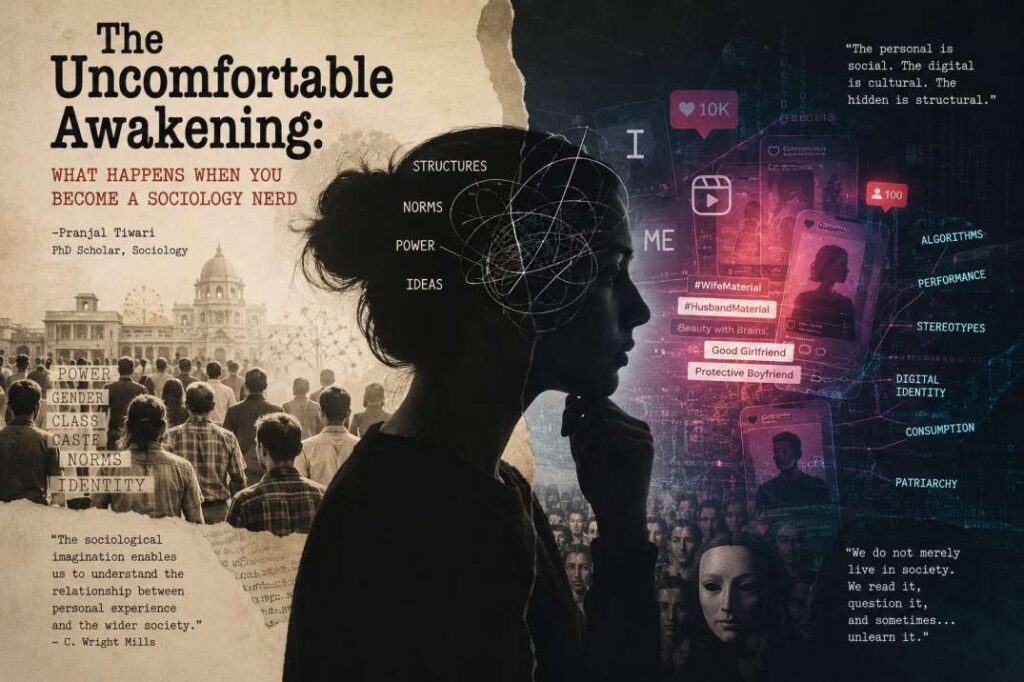
You start observing patterns everywhere in people’s behaviour, in conversations, in institutions, and even in everyday interactions. You begin “reading” society rather than simply living in it. It’s not always about judging people, but more about observing and understanding them sociologically. You notice how gender roles operate, how power works subtly, how language carries prejudice, and how society normalises certain behaviours.
Slowly, you also begin to understand that ideas like “good” and “bad” are not always absolute. Just as Claude Lévi-Strauss talked about binary oppositions, society constantly divides things into categories. But then thinkers like Jacques Derrida make you deconstruct those binaries and search for meanings beyond words and fixed definitions.
Recently, I’ve realised how much sociology has changed the way I think. I find myself becoming critical when people sexualise objects unnecessarily, casually give sexist examples, or crack misogynistic jokes without realising what they reflect about society. Sociology has made me critically conscious of things that once appeared “normal.” And maybe that is both the beauty and the burden of becoming deeply immersed in sociology.
And then there are matrimonial apps and social media algorithms that starts bothering you once you begin looking at them sociologically. Matrimonial platforms no longer appear to be just spaces for finding a partner; they begin to look like digital marketplaces shaped by patriarchy, gender expectations, caste preferences, class status, and beauty standards. A woman’s profile is often expected to display qualities that society defines as “ideal” fair skin, beauty, slimness, traditional values, caring nature, and yet simultaneously “modern.” Men and women both end up reproducing these expectations, often without realising how deeply gendered they are.
The more you observe, the more you notice how normalised these structures have become. Even social media algorithms start feeling sociological. Instagram constantly pushes reels about being “wife material,” “husband material,” “good girlfriends,” “protective boyfriends,” or phrases like “beauty with brains” as if beauty and intelligence are naturally separate qualities in women and it is somehow surprising when both exist together. These labels may appear harmless or romantic on the surface, but they quietly reinforce stereotypes about gender, relationships, femininity, masculinity, and social roles.
And once sociology enters your mind deeply, these things stop feeling like mere entertainment. You begin seeing how algorithms reproduce societal norms, how digital culture shapes identities, and how patriarchy survives not only through institutions but also through memes, reels, jokes, trends, and everyday online interactions. Sometimes it genuinely becomes overwhelming because you can no longer consume society innocently you are constantly decoding it, questioning it, and trying to understand the hidden structures beneath ordinary life.
And lately, I have started noticing something even closer to home the constant interplay of the “I” and the “Me” within myself and in the people around me. This distinction, a cornerstone of social psychology and symbolic interactionism first developed by George Herbert Mead, reminds us that the self is not a fixed, static entity but something that develops and continuously reshapes itself through interaction with others. The “Me” is the socialised self the part that has internalised the expectations of society. You see it clearly in conversations when someone hesitates before saying something, quietly self-censoring because they sense that a particular response might seem rude, inappropriate, or socially unacceptable. That pause, that internal check, is the “Me” at work, ensuring social control and predictability. And then there is the “I” the impulsive, spontaneous, creative aspect of the self that resists being fully tamed by social norms. It is the part that sometimes surprises even its own owner.
This becomes especially vivid when you interact with people who carry formal titles and credentials professors, doctors, officers, administrators. In their professional settings, they perform with great precision: measured words, composed gestures, authoritative tones. But catch them in an informal setting, at a gathering after hours, in a corridor without an audience, and you see something shift. The posture loosens. The carefully maintained persona softens. And without even realising it, Erving Goffman’s framework of front stage and back stage clings to your mind. The front stage is where the performance happens, where roles are played out for an audience with all the expected props and scripts. The back stage is where the mask comes off where the performed self gives way to something rawer, less rehearsed, more human. This is what sociology does to you. You stop attending gatherings as a participant and start attending them as a quiet, almost involuntary observer of social theatre.
And then comes Jean Baudrillard uninvited, as he always does. When you see the latest viral trend of AI filters that transform your photographs into a particular aesthetic the so-called “AI nano banana” and its many digital cousins it is impossible not to think of his concept of simulacra. For Baudrillard, a simulacrum is not simply a copy of something real; it is a copy that has lost its reference to any original reality. These AI-generated aesthetics do not reproduce the world as it is. They produce a hyper-real version of it images that look more polished, more atmospheric, more “artistic” than any actual moment ever was. People eagerly apply these filters to their photos, then share them as representations of their lives, their experiences, their identities. But what is being shared is no longer a document of the real; it is a simulation layered upon a simulation.
Now whenever I walk into a café or a Barista-style coffee shop, I cannot simply enjoy coffee without analysing the social space around me. Watching people order cappuccinos, americanos, cold brews, lattes, or espressos while sitting with laptops, clicking aesthetic pictures, or having long conversations makes me think about the sociology of taste and cultural capital. Coffee stops feeling like just a beverage; it starts looking like a subtle social symbol connected with lifestyle, identity, and class. Even the choice between a simple black coffee and a caramel frappé sometimes reflects different tastes, preferences, and forms of social exposure. At this point, sociology has made even an ordinary coffee outing feel like a small fieldwork observation.
The more I study sociology, the more I realise that cultural capital is reflected in the smallest parts of everyday life. Even the type of content we consume online, the books we prefer reading, the podcasts we listen to, or the pages we follow on social media subtly say something about our social exposure and tastes. Some people spend hours consuming self-help content, finance podcasts, political debates, art films, or literary discussions, while others engage more with celebrity gossip, viral trends, gaming streams, or meme culture. None of these choices are completely “neutral”; they are often shaped by our upbringing, education, class location, peer groups, and the kind of environment we grow up in.
Sometimes I notice how certain books, music tastes, or even intellectual references become markers of sophistication in social spaces. People casually mentioning authors, filmmakers, or niche music genres are not just sharing preferences; in many ways, they are also displaying forms of cultural capital. The algorithms may recommend content, but the ability to understand, appreciate, and engage with certain kinds of content is also socially shaped. Sociology makes me realise that our tastes often feel personal, but they are deeply connected with society, class, and socialisation.
Sociology should not remain limited to textbooks, theories, or examination halls. The real essence of studying sociology begins when you start applying it to everyday life. When café culture reminds you of cultural capital, when social media reflects identity construction, when advertisements reveal gender roles, or when ordinary conversations make you think about power, class, and socialisation that is when sociology truly starts making sense.
I believe students should not study sociology merely to memorise theorists and pass examinations. Instead, they should consume sociology in a way that allows them to interpret and understand real-life social realities through theoretical lenses. The beauty of sociology lies in its ability to make the ordinary appear deeply meaningful.
Once you begin to think sociologically, you realise that society is present in everything around you in tastes, spaces, relationships, language, online behaviour, and even in the smallest everyday practices. Sociology is not just a discipline to study; it is a perspective that changes the way you observe the world.
And perhaps that is the most exciting part of being a sociology nerd you no longer just see things you begin to decode them.
“The familiar, just because it is familiar, is not cognitively understood.”- G. W. F. Hegel

Pranjal Tiwari is a UGC-NET qualified doctoral researcher in Sociology at Chhatrapati Shahu Ji Maharaj University (CSJM), Kanpur. Her academic interests encompass the sociology of education, sociology of gender, and the theoretical foundations of sociological thought. She completed her Master’s in Sociology with a dissertation on the digital divide, gaining substantial research experience in the process. Beyond academia, Pranjal is an active writer and a published co-author in two literary anthologies. She is committed to contributing meaningfully to sociological Research and aspires to a career in academic research and teaching.