
Sometimes the internet brings us moments of joy, whimsy and hilarity, like a bird with a worm. These unplanned and unintentional moments resonate with people for they share a common thread: the unmistakable follies of humanness. A lawyer in an online civil forfeiture hearing during the pandemic accidentally put on a cat filter and couldn’t take it off. The video became the viral zoom cat lawyer meme. The grim days of the global pandemic had many such brief moments of respite from the dread of the fast spreading virus. Such viral video conferencing mishaps, in fact, predate the pandemic. A viral video from 2017, “The BBC dad” had children barge in, as their dad attended a BBC interview discussing South Korean Politics. It felt like a scene straight out of a sitcom. The comic timing in these often low quality videos is perfect for it is the humour of our everyday life itself. Having said that, one cannot gloss over the inconvenience and/or trouble it can mean for the people in these clips; ranging from getting recognized in the streets to security concerns especially for minors. But what if the algorithm found a pattern, learnt what can bring out the laughs and started generating these videos from scratch? While getting fooled by an AI generated video is indeed uncanny, the potential problems go beyond that mild discomfort. Humour does not exist in a vacuum. It has liberatory potential but can also regurgitate problematic tropes. Which way does AI lean?
Sexism and Misogyny in AI Generated Humour created for Engagement Farming
Patriarchy often dictates that men are the funnier gender. Historian, Joy Wiltenburg, debunks this myth (Wiltenburg, 2022). She suggests that this notion originated not so long ago and gained traction in the 18th century and onwards, when comedy became a profitable venture. Women were pushed towards domesticity and male professionalism took over the comedy scene. On one hand a certain masculine comedy excludes women, on the other hand, women are made the butt of sexist jokes. This doesn’t only serve the purpose of bringing out the laughs, but is a public performance of manhood itself. Women on their part have used humour subversively to challenge patriarchal domination. Needless to say, humour is a site where power asymmetries are challenged, reproduced and reconfigured. When AI tells jokes, the question then is, who is laughing and who is being laughed at. AI generated content builds upon existing social conventions, popular culture, existing online content and user preferences. The risk of replicating existing social hierarchies is incredibly high. AI generated humour is a testament to this predicament. AI is used to create sexist allegedly funny content and the programming often itself comes with a gender bias.
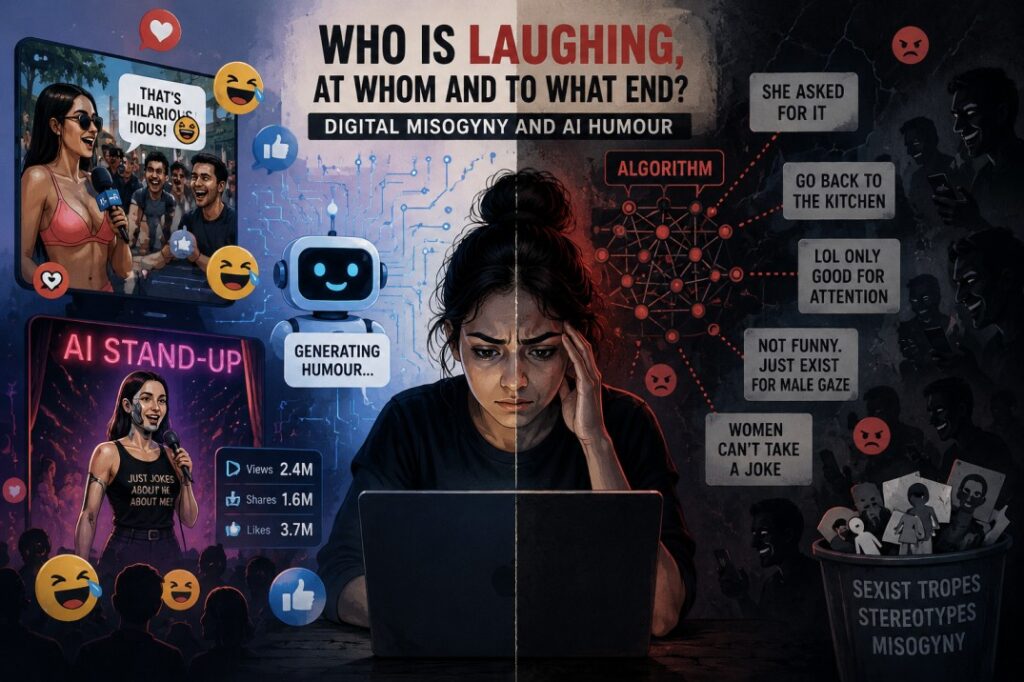
Many sexist AI generated reels have been doing rounds on the internet. One is where a short video includes a woman in a bikini taking a street interview of a man. The man says something lewd and the crowd cheers. The woman’s body is sexualized and exists only for male pleasure. In these reels she lacks any agency, exists only for the male gaze and to be punched down upon for the laughs. These AI generated women laugh at the inappropriate jokes sexualising them, the ultimate male fantasy. The underlying assumption is that women dressed a certain way and working in public spaces deserve to be sexualised. The joke would not have the same impact if the woman was donning traditional or so-called modest attire. Another genre is of AI generated women stand up comics. These AI generated women comics come onto the stage and crack jokes about sex, mostly objectifying their own selves. This content is disturbing on many levels. Moreover this content is nothing short of a mockery of the intelligent and amazing work of women comics and journalists. Such content, rewarded by the engagement metrics of views, shares and likes, perpetuates harmful ideas. These ideas easily translate into an increased risk of gender based violence and harassment.
AI Gender Bias in Humour: Exclusion, Stereotyping and Sexist Tropes
For the aforementioned videos, it can be argued that the script was misogynistic. At the end of the day, such use of AI is a reflection of the systemic social flaws, hierarchies and power imbalances. So, I decided to ask AI to tell me jokes with a neutral prompt. First I asked chatGPT to tell me a joke, the theme being women. Here are some jokes it generated
1. “My girlfriend said I never listen to her.
At least… I think that’s what she said.”
2. “A woman asked her husband to pass her lipstick.
He accidentally handed her a glue stick.
She still isn’t talking to him.”
3. “My wife told me I should do lunges to stay in shape.
That would be a big step forward.”
Most of the jokes were from the point of view of a man. Moreover in all of them women were either girlfriends or wives, more or less, following the nagging wife/girlfriend trope. Next I asked chatGPT to generate jokes with men as the theme.
1.“Men buying one item at the grocery store:
Mission. Precision. Tactical extraction.
Men buying more than three items :
“I should’ve made a spreadsheet.”
2. “Men treat carrying all the grocery bags in one trip like it’s an Olympic event.”
3. “A man can remember a football score from 2009…but not why he walked into the kitchen”
These jokes explore the inner lives of men without limiting them to certain roles in relation to women like husbands or boyfriends. It also normalises the weaponised incompetence that men sometimes use to avoid household chores by giving it a fun twist. These results speak for themselves. AI humour marginalizes the point of view of women, reduces their identity to wives and girlfriends and builds upon sexist tropes. While chatGPT will refuse to comply if directly asked to write sexist jokes, there are AI models out there without such policies. AI is making the digital landscape more precarious for women and this needs to be taken into consideration when discussing the implications of artificial intelligence, model training and critical digital thinking.
Laughter as a Social and Political Act: Conformity and Resistance
“Men are afraid that women will laugh at them. Women are afraid that men will kill them.” – Margaret Atwood
Men are infamously averse to women comics. Their content, accused of being dull and boring. Interestingly, women comics often tend to borrow from their lived experiences. A fifteen minute standup can potentially be a scathing critique of patriarchy. While women comics, as claimed by men, so often fail to tickle their funny bone, these AI generated women comics follow the ‘locker room’ and ‘sexist whatsapp forward’ brand of humour popular in male dominated private group chats. These AI generated women wear sexualized clothing and tell self-sexualizing and sexist jokes. Their jokes either humiliate men who don’t display masculine control and/or ridicule women for transgressing expected gender codes of dominance and submission.
Such AI generated reels usually end with a laugh track. While this cue to laugh may or may not work in bringing out the laughs, it indicates that the content should be seen with a sense of humour, diluting accountability. This is also made clear with the use of hashtags like #aifunnyshorts. Billig (2005) invites us to think about humour not as a strict dichotomy but as fluidly moving between disciplinary and rebellious functions. What purpose humour serves in a particular context can be discerned by the social location of the people involved, whether it entrenches existing hierarchies or challenges them and its implications with respect to conformity and change. Humour sexualising women is dehumanizing and dangerous and the kind of humour reinforcing gender roles signals that the patriarchal way of life need not be challenged. It is deeply conformist in its connotation. Despite this genre of humour clearly aimed at disciplining and controlling women, it is often framed as rebellious by dark humour fanatics. The argument made claims that progressive politics polices everything, even jokes. This allows any critique of such humour to be painted as controlling, uptight and as not having a sense of humour. The question, when simplified, reveals the hollow nature of the conservative argument. Whose power is being reinforced, whose subordination justified and who is being put at a greater risk of violence and harassment? As new technologies accelerate the production and dissemination of misogynist content and reflect gender biases, the digital public space becomes even more unsafe for women.
(Note: In chapter 8 of Laughter and Ridicule, Billig uses the ethically dubious, dehumanizing and now debunked work of Turnbull on the Ik people of Uganda as a case study for ‘unlaughter’ .The framework used in this article of disciplinary and rebellious humour, does not borrow from the example and is independently developed in Chapter 9 of the Book )
References:
Billig, M. (2005). Laughter and ridicule: towards a social critique of humour. https://doi.org/10.4135/9781446211779
Wiltenburg, J. (n.d.). Just when in history did men decide that women are not funny? Psyche. https://psyche.co/ideas/just-when-in-history-did-men-decide-that-women-are-not-funny

Shimaila Mushtaq is a Political Science graduate from Jamia Millia Islamia.