
About: Umar Siddiqui is an author, essayist, and creative thinker whose work explores themes of creativity, mental health, connection, fashion, music, identity, and personal growth. He is the author of Inventing Your Exit, a unique collection that combines playlists, essays, and poetry to encourage readers to look within, embrace creativity, and take an active role in shaping their lives.In addition to his writing, Umar is the founder of the Sincerely Siddiqui brand, where he designs and promotes his own garments and creative projects. Website: http://sincerely-siddiqui.myshopify.com
Instagram:@sincerelysiddiquibrand (Brand)@uniquelyumar (Writing)@umarrrzy__ (Main Account)TikTok:@siddiquispoken
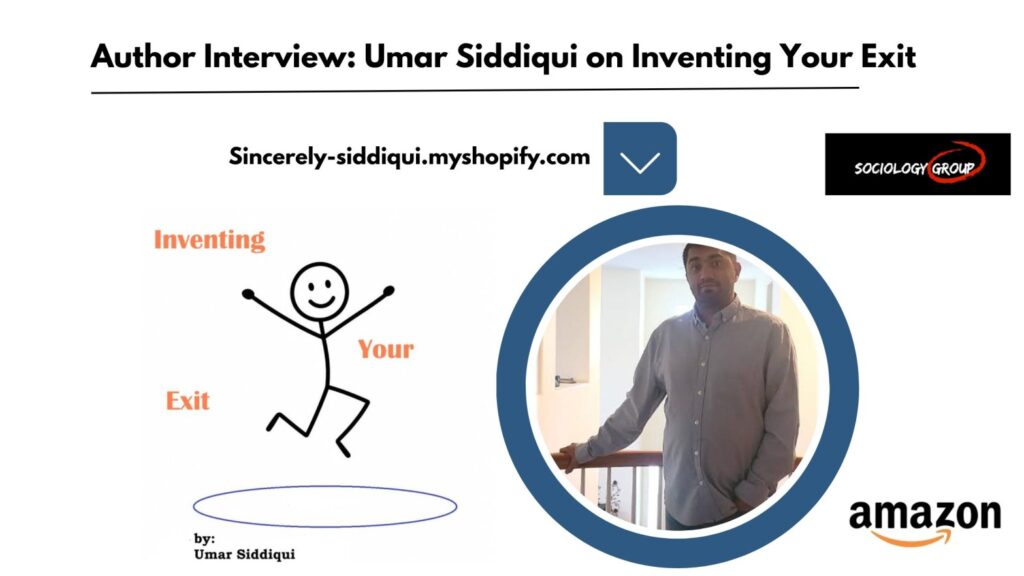
Welcome to our interview series, Umar Siddiqui, and congratulations on the release of your fifth book, Inventing Your Exit. Your book brings together playlists, essays, and poetry in a very personal and reflective way, exploring themes of connection, creativity, music, identity, healing, and self-discovery. We’re excited to learn more about the ideas and experiences behind your work.
Inventing Your Exit feels very personal and emotional. What inspired you to create this book?
You may recall I have written a less essay-oriented, more traditionally structured book on mental health. Here the themes of creativity, power, and vulnerability remained consistent. They underlie mental processes. The book is called Float Your Boat: You Have Power and Control, and I wanted to further that discourse. I felt I had so much more to say, and I know writing is a pointed strength of mine, so I decided adding in playlists would make it more user-friendly but also unique.
I have a few essays on mental health in it and a few on fashion. I recently have expanded my interests and horizons, so I wanted to further the connection with daily life.
What inspired me is that life is short, and you’re on this Earth once. If you live this life, you might as well live smartly and to the fullest. You should thrive vigorously. I want to be a force and vehicle to assist people to do precisely that. I want people to see it is not difficult, but I also want them to know life takes work. To materialize your wishes and dreams beyond just manifesting them, you have to be an actor and benefactor for yourself.
Your book combines playlists, essays, and poetry together. What made you want to tell your story through different creative forms instead of just one?
I have always loved writing, and it has always aligned with me. I think the playlists were a more personal way to connect. I share my playlists on TikTok and receive reactions, so I knew they were engaging. I decided to blend my love for writing with my love for listening (to music) into a creatively-oriented book. If my goal is to reach people in the idea that they should be creative, I want to approach this goal in an imaginative way.
I had the playlists saved on my phone and computer, so I compiled them. I added in my poetry and my left over essays to weave a book together that positively and imaginatively encompasses creativity and themes of connection and looking within you!
Music plays a huge role throughout the book. What is it about indie and alternative music that connects with you so deeply?
It definitely does play an enormous role throughout the work. I love that alternative and indie are umbrella terms for diversity in rock-oriented music. I have always been a fan of more guitar-driven music. I tell people my favorite female-fronted band is Florence + the Machine, and I like that her voice is very soulful. I like that she is very artistic in her choice of instruments and her lyrics as well. Her band is sometimes described as “art rock” or “art pop.” I was not always familiar with this type of music, but I have always loved more unique, experimental approaches to music. Two other bands that lend themselves to “art rock” are The National and Arcade Fire. I just deeply love this type of music. I believe it adds another dimension to the lyrics and themes in the storytelling of the music.
Your playlists move between energetic songs and softer emotional moments. How do you usually build a playlist, through feelings, memories, or a certain atmosphere?
Ever since I started making playlists, I always made sure to focus on versatility and varying moods. I always make sure to have more atmospheric or acoustic songs on my playlist (one or two) and balance them with harder music. I also add those more experimental tracks, so my playlist can stand on its own and encapsulate a lot of different styles.
One of the strongest themes in your writing is connection. Why do you think so many people today struggle to feel connected with themselves and others?
That is a though but fraught and pressing question! I do very conspicuously like to focus on connection, because I feel like that is a dire need and that it is fleeting. That is why people struggle for connection. Two reasons are at play: the world is fragmented, and also because we look in the wrong places.
The world ails for understanding. If we all were more global and connective with an approach thriving and not just living, we would automatically see connection as easier and more fluid.
We look for connection in the wrong contexts but also in the wrong spaces. It starts with us. Connect with what resonates with you and within you. It will automatically make sense. There is a sensibility that is not readily visible, but we have to strive to see it in connection. Then we will see connection itself and feel it as well.
In the book, you write, “Reality is how an individual perceives the world, because it is their reality.”Do you think people experience the same world in completely different emotional ways?
The answer is a resolute yes! Sure, we all ascribe to this vast world, but your world is different from my world. There is the lens of experience. Through Maurice Merleau-Ponty’s notion of phenomenology, we can attest to the fact that we indeed do experience the world differently. We have different perceptions of space and time that shape our realities.
We ascribe to different affiliations, subcultures, and communities, and as such, as will have different worlds we come from and into which we go. It might be temporal and transient, and we can be seen as nomads and/ or travelers. We contribute our own worldviews to a collective reality.
Your essays often turn everyday things like fashion, fitness, or music into something deeper and meaningful. Have you always looked at life this way?
These are inherently meaningful, and they pose meanings. We have to pull the meaning out, however. We have to first see what the meaning is at its surface. These are very sensory fields, but they are very obvious in our growth and development.
Fitness is a form of development, and it is a lifestyle. You hear the phrase “trust the process”, because in doing so you are enjoying the journey and winning the smaller battles. That is what I see as integral to fitness, progress. The progress is one you obviously see but also feel. I feel my fitness, and it gives me pride and gratefulness. It helps me connect intrapersonally (within) and spiritually. I am privileged to work out, because I know I have drive to work out. Some people are not so fortunate.
Fashion is something I have written two books about. One book, Candid about Couture is more philosophical while the other one, Stylistic about Style, can be a little more technical as it guides through research. Fashion and music are both arts. They can intertwine, and in my rather long fitness essay, I have tried to intertwine advents in fashion and fitness.
I have never taken life superficially. I have rather lived it subliminally. I take the meanings out of everything I encounter. My environment, to me, poses more than my surroundings; it is my context. There is much, much more to living than just observing passively. There are meanings that underlie virtually everything.
Fashion appears throughout your writing not just as style, but as identity and self-expression. What first made fashion personally meaningful to you?
Fashion is ubiquitous and vocal. It exists virtually everywhere with different connotations and interpretations of it. One of my longer essays in the book tackles style “head-on.” I know that is a cliché, something fashion should not be. It should be visible, meaningful, and personal.
It automatically communicates myriads of ideas and concepts in public. We have to be vigilant of these messages but not overthink them. That is the challenge, but it is intuitive. It is within you, and there is no one answer to fashion’s questions or the questions we pose as participants in realms of fashion.
That is what chiefly draws me towards fashion, the fact that there is style. I often find it difficult to define the difference between style and fashion, although I have studied this extensively. The answers are many and various. I would just say a style is an iteration or spin on a fashion. Fashion is how a garment, accessory, or look is accessible, and style is what we do with it.
You write openly about vulnerability, healing, and mental health. Was it difficult to share those thoughts so honestly?
I just feel like I can be open and candid about such themes. It is not difficult to me. I like to see that my experience can aid others, so being open also means having open arms. I want to encourage and welcome readers to feel catharsis and to generally feel healed and better. I want to establish a rapport or connection with them so they can proceed.
I want my words to resound and have a presence in readers’ minds. I believe we are all thinkers. We evidently are and are hardwired to be. We, as such, should exercise thought and establish a flow in thinking.
I remember in social psychology, which I took a very long time ago, there was a term, “cognitive miser”, and it pointed to the idea that humans do not like to think. I would beg to differ, and if I genuinely cannot, I would like to change this ideal.
One thing readers may notice is that your writing feels very human and conversational rather than overly polished or distant. Was that intentional from the beginning?
I really appreciate you saying that. It is so important not to feel impersonal, which if I have to be honest and critical, I would say fashion and media are nowadays. In fashion, I see tiers and hierarchies. It just feels like a competition as a whole. In the luxury or high fashion sector, there is so much inaccessibility that it is depressing.
In media, the news cannot connect with the audience. All I see is off-putting content and repetition. I think there needs to be systemic change here.
Anyway, yes I have always made it a point to connect. In books, it feels like a one-way conversation, but I have never seen discourse as a one-way phenomenon. It begs to be multidirectional, and it should really be treated this way. You should aim to welcome other thoughts and insights into your milieu, looking to advance and enhance!
In the book, you say, “Curiosity will not take away from you- you literally won’t lose anything when you gain so much.” Has curiosity ever changed your life in an unexpected way?
It is definitely an approach and lifestyle of mine to be inquisitive to no bounds. It is important to question everything, because it is how you grow. Being curious is an art. Being inquisitive is an element of that, because asking questions is a central part of being curious. Being perceptive, receptive, and observant count.
Being perceptive, to me, is being understanding, agreeable, and sensitive. It is key to functioning in this expansive world. Currently, being perceptive is a core skill to any job. You must learn to work with others in most of your roles in life.
Being receptive, to me, is to receive insights and take feedback constructively. leads to being responsive but proactive. Being proactive grows directly from being reactive, so you are listening intently and seeking to improve yourself, not listening to trigger yourself or react.
Of course, being observant goes hand-in-hand with these. Observing consists of absorbing your surroundings but also being critical about them. You have to be discerning in some capacities to make decisions and to succeed. You need to make judgements about personalities, style, environment, relationships, etc.
Your work references music, art, media, Disney, communication, and culture all together. Do you think creativity becomes stronger when different worlds and interests connect?
These items that have been named are many of my passions. Arts, namely fashion and fine art, entertainment, media, and popular culture, where Disney is concerned, communication, social dynamics, and mass communication, in my education, are all areas which I love to be involved and invested in with my resources and energy.
These aspects of my life are integral and indispensable to me and make my life purposeful and meaningful. They make not just creativity stronger but connection (internally and externally) stronger.
The title Inventing Your Exit is very intriguing. What does that phrase personally mean to you?
Thank you for saying that! The phrase is meant to give you the realization that is your responsibility to create or find your way out of your problems. No one else is required to do so. It is meant to not overwhelm people into the responsibility of “inventing their exit” but rather to inspire and encourage them to do so. It is meant to give space and liberate a person or people to be innovative in finding an outlet from whatever issues they are facing, and it encompasses the theme of power being in one’s reach.
While writing this book, did you discover something new about yourself that surprised you?
I proudly prescribe the idea that everyone needs to actualize. As a matter of fact, I know it is a need as per Abraham Maslow’s hierarchy of needs. I prescribe this as preliminary to all peers when providing sound advice or just talking people through their emotions and needs. We all need connection and assurance. Rest assured, this is available to all beings in different modalities and capacities.
I learned that I can improve. I also proudly say I am an actualized person, but I also believe I can always improve and evolve. I can control things that trigger me, but I feel there is always more. There are triggers; then there are stressors. These can grow, so I want to get a handle on them.
I learned additionally that I can be critical of myself, which is something that shows maturity. Everyone should be able to point the finger in their own direction and know the different between self-criticism and degradation.
Finally, what do you hope readers feel after finishing Inventing Your Exit?
Obviously, the playlists are music I love, not necessarily what others love, but it should be a ground for bonding and, again, connection. It communicates personal meanings that we should be able to understand. What I want readers to gain is a lens. It is a way to look at the world and the arts as language. The lexicon and colloquialisms we use to communicate do not just affiliate us with groups, but they also aid us in connection.
I want readers to take responsibility and accountability for themselves. That is a vague statement, so I will clarify as best and succinctly as I can. I want them to heal by looking within. Never play the victim. Victim mentality is something like drawing pity and is not healthy or an option. I want readers not to engage in “playing the victim.” I want my readers to be strong, both physically and mentally, and I want them to take on ailments and trials headfirst. I want them to celebrate the small wins and look for them in all sorts of places. I have seen that they can come when least expected!

We believe in sharing knowledge with everyone and making a positive change in society through our work and contributions. If you are interested in joining us, please check our ‘About’ page for more information