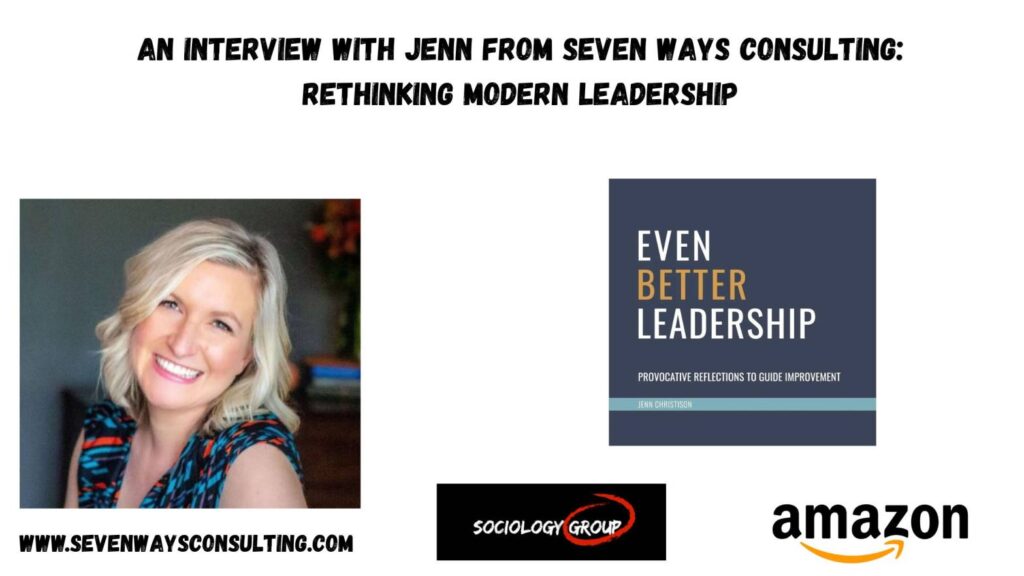
About Author: Jenn Christison grew up wanting to change the world as a teacher, social worker, or stand-up comedian. After exploring all three, she discovered her most significant impact could be made by leading organizational transformation. With over 15 years of experience as a performance improvement consultant, senior leader, facilitator, and coach across multiple industries and sectors, Jenn brings a wealth of expertise to her work. Her educational background in Society, Ethics, and Human Behavior has shaped her improvement framework, emphasizing team and leadership development alongside technical process improvement. Committed to the principles of respect for people and continuous improvement, Jenn owns and operates Seven Ways Consulting. She helps motivated leaders become even better through custom coaching, facilitation, and education services. Known for her upbeat, optimistic approach, Jenn encourages hands-on experimentation that enables rapid, engaging improvement. In her spare time, Jenn enjoys reading fiction, inhaling the scent of Pacific Northwest pine trees, and baking treats for her loved ones. You can still find her playing stand-up comic if you know where to look.
Welcome to our interview series, Jenn. Thank you for joining us today. Please start by describing yourself in your own words and sharing a little about your background.
- You grew up wanting to be a teacher, social worker, or even a stand-up comedian. Which parts of those early dreams still influence the way you help leaders today?
Honestly, I feel incredibly fortunate, because each of those early dreams still influences how I help leaders today. As a young person, I wanted to be teacher because I was lucky enough to have some wonderful teachers who saw my potential, understood what made me tick, and encouraged me to be my best. Overall, I really enjoyed the learning part of school. I especially appreciated teachers that made me pause and reflect on what I really believed. Those skills stuck with me – explaining my reasoning, proving my opinion, thinking critically. And the ability to create a trusting environment where students feel safe and encouraged to do that, to acknowledge what they don’t know and put effort into learning new skills and be evaluated on it…to do that well…I take that very seriously.
My interest in social work was born out of realizing how many ways our structures and systems let us down sometimes. When things are broken, I want to help fix it. When people have trouble navigating complexity, I want to advocate on their behalf or give them access to the resources they need to advocate for themselves.
As for stand-up comedy, well, I am known for always looking at the bright side and finding humor even in my darkest times. Reality bites, and it is funny. I am naturally direct and able to see multiple angles to most any situation. Absurd, bizarre, relatable.
In my current role as a leadership coach, I really do embody all three. I strive to create a safe and engaging learning environment. I give people the tools and resources they need to advocate for themselves in, or even fix, broken systems. And when all else fails, we can be honest about how difficult and absurd it all is and laugh about it together, hopefully giving us the strength to keep trying.
- What moment made you realize that organizational transformation was the space where you could make the biggest impact?
Looking back, no matter what job I had, or what company I worked for, I was the person people came to for advice or to join their project team. It seemed I had a knack for quickly learning workplace processes and systems, identifying what could be even better, and engaging others in making better happen.
And as it turns out, there are jobs that do that!
I saw there was a job with The Boeing Company as an Employee Involvement Facilitator, working with front line leaders to create an environment of high-performance by teaching teamwork, conflict resolution, communication, and problem-solving. I applied, I got the job, and my career took off from there.
- How did your studies in Society, Ethics, and Human Behavior shape how you understand people, teams, and leadership?
My formal education reinforced the value of interdisciplinary, systems-thinking. Of connecting the dots across different ways of thinking and approaching problems. How surroundings and context and timing shape our beliefs and actions. This is all directly applicable to the workplace. It is easy to become limited by our own perspective, based exclusively on what we have known to be true, or what we have experienced firsthand, or heard about from friends.
But reality is far more complicated than that. Humans are messy creatures, full of contradictions – and also capable of incredible things. Then we get crammed together in a work environment that may or may not support us being our best selves. Learning how to take a step back and view what is happening from a more removed, analytical perspective, taking in context, bringing in what is possible from elsewhere, is foundational to how I approach my work. This fresh perspective, distance is one of the biggest benefits of working with an external partner.
- Before starting Seven Ways Consulting, what experiences shaped the optimistic, practical coaching style you bring into your work?
Improvement requires both optimism and practicality. You really can’t have one without the other! I’m naturally inclined toward both, and my early experiences leading improvement work for large organizations validated that and really shaped how I coach today.
I learned pretty quickly that you won’t get far if you don’t believe things can be better. At the same time, belief alone doesn’t change anything. Improvement can feel overwhelming, especially when leaders are exposed to lots of theories, models, and tools without a clear place to start.
What I saw, again and again, was leaders getting stuck not because they didn’t care or weren’t capable, but because the work felt too big. That’s where my coaching style comes from. Sometimes leaders don’t need yet another framework. They need someone to remind them what’s possible and help them take the first step.
- What inspired the name “Seven Ways Consulting,” and what does that name say about your approach to leadership development?
Seven Ways Consulting is named after one of my favorite facilitated activities. Without getting into all the nerdy details, when designing a new space or process, the team is instructed to come up with at least seven different ways of solving their problem. As an additional challenge, all ideas must be hand drawn. Pushing past initial assumptions to generate seven distinct options requires focus and discipline. Requiring ideas to be made visual through drawing channels creativity and ensures clarity of thought. If you cannot make your idea visual, then it may still be too complicated to explain, design, and implement. Immersed in paper, pencils, and plenty of laughter, the entire activity brings people out of their comfort zone and ready to learn.
Additionally, the team is encouraged to look to nature for inspiration from time-tested, elegant solutions. Trying to figure out how to move heavy parts across a factory more efficiently? Consider: How do ants move things? What aspects of their situation might apply to ours? Now draw it out! It may sound silly (and it can be!), yet engaging our brains in this way uncovers opportunities and perspectives otherwise undiscovered. It forces us to deeply understand what problem we are trying to solve before getting attached to traditional solutions.
That philosophy is at the heart of how I work today. I do not believe in “one size fits all” solutions. Your situation was created by a unique mix of assets and liabilities, strengths and weaknesses, luck, and hard knocks. Thus, your solution needs to be tailored to fit your problem. Your path forward is specific to you, and there are many ways we could approach building it.
- When leaders begin Executive Coaching with you, what is the first mindset shift you hope they’re open to making?
This might be a controversial statement — and I say it with compassion, not judgement — but I only accept Executive Coaching clients who are willing to acknowledge the uncomfortable reality that they are part of the problem. Work environments are complex systems – and we all contribute to them.
- Teams often struggle with trust or communication. What is one simple action you use to help teams move toward more open and healthy collaboration?
There’s a common saying: A relationship without trust is like a car without gas. You can stay in it, but you won’t go anywhere. And while building trust requires deliberate effort, it is not a difficult process. Research from The Gottman Institute suggests that to create an atmosphere of trust, your colleagues should experience feedback from you at a ratio of 5:1, with the majority being positive. Feedback includes everything – words, tone, body language, and actions. In other words, to build trust, start the relationship on a positive note.
So the one simple action is to create positive encounters – share a smile or laugh, give compliments, say “okay, let’s try it” when someone shares an idea. I think of it as building a relationship bank: essentially, “deposit” plenty of positive encounters in your bank so that goodwill exists before you need it.
- As a keynote speaker, you mix insight, optimism, and humor. How do you use humor to help people open up to new ideas?
When we laugh at something together, we realize we have something in common. We understand each other a little bit. We have a similar perspective. So not only is sharing a laugh fun, and makes us feel good, it also builds camaraderie and trust. We feel understood. And when we feel understood, we become more receptive to learning new information.
Plus, humor requires perspective. It is the result of stepping back, connecting dots, and creating playful insights. When done well, it helps others see what else might be possible.
- Your workshops are very hands-on and experiential. What makes this active style of learning so effective for leaders and teams?
Improvement takes practice – just like anything else! And you and your team can only go as fast as YOU can go. So, you may as well get started now. Learn what aspects of the change are actually easy for you. And which ones might take even more practice than you initially thought. Ultimately, hands-on learning makes it all real and builds confidence.
- In your consulting work, what service or type of support do leaders request the most today, and why do you think it’s in such high demand?
Goal setting and prioritization. It has always been goal setting and prioritization. I think these topics are consistently in high demand because they are a foundational aspect of leadership that happens every single year, continuously. Plus, they both take a lot of practice and are inherently iterative.
Effective goal setting requires multiple back and forth conversations, up, down and around the entire organization. It’s a lot to keep track of! And most leaders aren’t taught the biggest secret to good prioritization: upfront project planning. Too often, leaders are prioritizing ideas not actual work. It is much, much easier to say “no” or “not now” when you understand what it will take to actually complete the work. And again, this requires multiple back and forth conversations and is a lot to keep track of.
- Your book Even Better Leadership has a bold, playful, visually engaging design. What motivated you to move away from the usual leadership-book format?
I have always been a big reader, ever since I was a kid. I fondly remember sitting in my bedroom, surrounded by my favorite books, looking them over and choosing which one to read (or re-read!) next. And I still have them – all of my childhood favorites. Children’s book are designed to be engaging. They are created to be held and to hold your attention. They are intended to be read over and over, as a bedtime story or a silly moment shared with a sibling. I wanted my book to evoke those same feelings. Leaders are busy, overwhelmed, and exhausted. It is hard to make time for reflection and change. I wanted my book to be something you look forward to.
- The book is centered on 12 foundational leadership responsibilities. How did you select these responsibilities, and what do they reveal about leadership today?
The earliest version of my book was missing something important: my point of view! The first iteration was simply a collection of interdisciplinary reflection questions designed to spark creative thinking. About halfway through, I stopped and asked myself: What makes this a leadership book? Why is it especially relevant for leaders?
I realized I was only offering half of my coaching approach. Open ended questions are powerful, but when people are struggling at work, they often need something to react to. They need an opinion — something to agree or disagree with — in order to clarify what they believe.
I began listing the leadership responsibilities I consistently see across industries, as well as the gaps, those things that are frequently missed. I started with more than 50, then narrowed the list down to the 12 I believe are most critical to creating an environment of continuous improvement.
- Many leaders struggle to slow down and reflect. How did you design your prompts to help them pause, think deeply, and still move toward action?
The book is designed to be tackled one responsibility at a time, over the course of a year or at least a few months. I kept the prompts focused yet rigorous; each one requires at least a few minutes to process and form one’s own opinion. Each chapter ends with a series of “call-to-action” questions, helping the reader translate what they learned into to actionable next steps.
The intent is to make it easier to pause and reflect while simultaneously building momentum.
- The book blends creativity with practical guidance. Why was it important for you to make leadership development both fun and meaningful?
Leadership can be exhausting! The evenings, the weekends, the daily emergencies. With that reality in mind, I wanted to make professional development something to look forward to. A productive version of “me-time.” I intentionally drew inspiration from childhood learning experiences. That time in our lives when learning came naturally, and felt more playful, engaging, and full of possibility.
- With over 17 years of cross-industry experience, what is one major shift you’ve seen in how organizations view leadership?
Leaders are expected to do and be it all and appeal to everyone. Provide clear direction…but don’t tell people what to do. Give feedback…but don’t hurt feelings. Be vulnerable…but make sure you always instill confidence. Be authentic…but don’t alienate anyone who might be different than you. Be inspirational…but also make sure you perfectly achieve all your daily targets. It’s exhausting and unreasonable.
Yes, I have extremely high expectations of those in leadership positions. After all, other people’s careers, their livelihoods are in your hands! And, leaders are humans, too. They also deserve compassion, and the tools, resources, and support to do their best work.
- When a leader feels overwhelmed or stuck, what is the single question you ask that usually helps them find clarity?
Oooh, great question! Probably some variation of “Why is this so important right now?” Taking a step back to identify what really matters and why can quickly cut through overwhelm. Or, if they seem really upset, “What do you need right now?”
- From your perspective, what emerging leadership challenges or trends do you see shaping the workplace over the next few years?
The ongoing reality of being constantly “on blast.” Strong opinions and competing realities amplified by social media, with very little nuance. Leaders are experiencing information and emotional overload. Successful leaders will be the ones who create more time to think, gain clarity, and act with calm intention.
- With the world moving so fast, new technology, new expectations, what is one thing you believe every leader should pay closer attention to right now?
Where they are focusing their energy. Period. Eliminate as many distractions as possible. Leading with intention requires clarity and energy. Give yourself the time and headspace to THINK and be deliberate.
- For someone considering buying your book, what makes Even Better Leadership stand out from the leadership books they may have read before?
Even Better Leadership is quite different from most other leadership development books. First, it is designed to be engaging to look at and interact with. Every page is brightly colored, and it is square! Each chapter revolves around a different leadership responsibility and describes what it looks like when that responsibility is performed well. The rest of the chapter provides a series of reflection questions to engage the reader in forming their opinions, evaluating their own performance, and thinking creativity. Each chapter ends with questions to guide action planning.
It is more like having a personal coaching conversation than reading a book. A writing utensil is strongly encouraged. It is designed to be used, not just read.
- If a company or leadership team wants to start developing “even better” habits immediately, which of your services or resources would you recommend they begin with, and why?
They could certainly buy my book! It is available via Amazon or direct from the publisher at BookBaby.com. When you buy from BookBaby, you can use the code EVENBETTER25 for 25% off, on me.
Or I would recommend any of the free Toolkits on my website. They currently include cover goal setting, team development, and building trust through feedback.
And of course, leaders are always encouraged to reach out for a conversation. Let’s talk it out! Insights usually emerge when we do.

We believe in sharing knowledge with everyone and making a positive change in society through our work and contributions. If you are interested in joining us, please check our ‘About’ page for more information