
David Chaffetz is an independent scholar with a lifelong passion for Middle Eastern and Inner Asian history. His 1981 book, several times republished, A Journey through Afghanistan, earned praise from Owen Lattimore, the then doyen of Inner Asian studies in America and the UK. He is a regular contributor to the Asian Review of Books, and has written for the South China Morning Post and the Nikkei Asian Review. His most recent book, Three Asian Divas, describes the important role of elite women entertainers in the transmission of traditional Asian culture.
A graduate of Harvard University, Chaffetz had the privilege of studying with two great scholars of Inner Asia, Richard Frye and Joseph Fletcher. At Columbia University he was editor of the Columbia Journal of International Affairs and a student of the noted Central Asian specialist, Edward Allworth. In the forty years since, he has extensively traveled in Turkey, Iran, Afghanistan, Pakistan, India, China, Kyrgyzstan, Mongolia and Russia in Asia. Chaffetz reads and performs research in over 10 languages, including Persian, Turkish and Russian.
He is a member of the Royal Society for Asian Affairs, the Hong Kong Branch of the Royal Asian Society, the Explorers’ Club of New York and the Gremio Literario (Literary Society) of Lisbon. He divides his time between Lisbon and Paris.
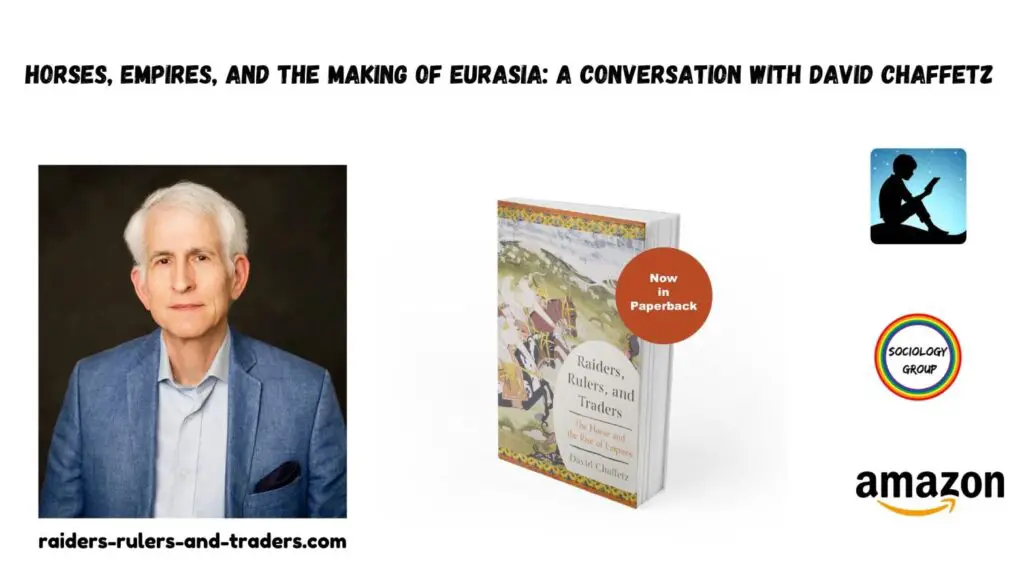
| 1. Raiders, Rulers, and Traders presents the horse as a major historical force. What led you to place the horse at the center of Eurasian history? | In the beginning was the horse. Without the horse one cannot explain the rise of the first empires, the competition for horse power, the emergence of trade routes across Eurasia and the centuries-long rule by horse breeding peoples over sedentary populations. |
| 2. You describe how horse-based societies shaped empires from ancient Persia to the Mongols. What patterns of governance or military organization did you find across these empires? | These empires considered horses to be a strategic resource, in the same way 20th powers looked at petroleum. Ensuring access to horse power, protecting grazing land, care and training of horses, and constant practice of hunting to ensure conditioning—these activities characterize all the great empires. |
| 3. In Raiders, Rulers, and Traders: The Horse and the Rise of Empires you propose rethinking the “Silk Road” as the “Horse Road.” How does this reinterpretation change our understanding of the historical dynamics that shaped Eurasia? | The notion of the “Silk Road” emphasizes long distance trade in luxuries over the “empty” steppe. On the contrary, the steppe teemed with people, who were active agents in world history, who traded steppe products, especially horses, with their neighbors and with one another, and who achieved wealth and a high degree of civilization. Only when this trade stopped in the 20th century did the steppe become impoverished and isolated. |
| 4. How did you approach combining written sources with archaeological and genetic data in this book? | Original written sources, like Herodotus, Sima Qian, or Rashiduddin, provide lively and compelling descriptions of the horse breeding peoples. Archeology and paleogenetic investigation provides almost uncanny validation of these old tales. For example, Herodotus describes the woman warriors, or Amazons, and we find tombs of princesses buried with their weapons. Genetic analysis shows that Herodotus’ horse peoples roamed as far as China, and that the ancient Xiongnu migrated from the Chinese border to modern Hungary. Without such analysis scholars had tended to dismiss the whole idea of long distance migrations. |
| 5. What challenges did you face in tracing a narrative across such a broad geography and long historical timeline? | I had to stick close to the horse. The life-style that grew up around horse breeding—raiding, ruling, trading– proves to have been very persistent and consistent over time and space. Over and over again it illuminates different historical events, from the war between Han China and the Xiongnu, to Tamerlane’s invasion of China 1400 years later, to Russia’s conquest of Central Asia. |
| 6. Horse breeding is presented not just as a technical skill but as a political tool. How was control over horses linked to political power? | Until the introduction of steam and internal combustion engines, horses uniquely provided transportation and communication on land. Any state which hoped to conquer and rule territory, since the Assyrians, had to maintain cavalry and some form of “Pony Express”. Rulers strove to obtain horses, more horses than their rivals. In turn this entailed controlling vast paces to pasture tens of thousands of horses. And of course only on horseback could one administer and defend such territory. So the relationship between the horse and political power was crystal clear—to everyone. This comes up again and again in the pronouncements of kings, emperors and viziers. |
| 7. In what ways did horses influence not only warfare and trade but also the cultural and religious life of the societies you explore? | Such was the outsized role of the horse in their daily lives, the animal captured a large part of their imagination: in epic poetry, where horses are on equal footing with heroes; in death where the horse conveys the soul on the final journey, and is buried with pomp alongside the rider. The horse comes to symbolize the soul itself, like the steed of Prince Siddartha Gautama, which attains enlightenment and becomes a Boddhisatva. |
| 8. What role did climate and environment play in shaping the horse-centered civilizations of Eurasia? | The horse breeding peoples suffered from the extreme weather conditions of the steppe. Unusually cold winters and lack of rain in the spring periodically devastated their herds. Unlike farmers, they had limited ability to store away food for emergencies. This has led some scholars to argue that bad weather correlated with periods of warring against the settled people. I argue, on the contrary, that warring required many and fit horses, so the raids resulted from the horse breeders having too many horses. This is consistent with the complaints of the Mongols to Genghis Khan, “our geldings are fat. What shall we do?” On the other hand, bad weather led to inter-tribal raiding, as people tried to replenish their herds by horse and cattle rustling. |
| 9. Which sources – textual, visual, or material – were most revealing in helping you reconstruct this history? | As mentioned, one has to review the fundamental texts, the Shiji of Sima Qian, the Histories of Herodotus, the Compendium of History of Rashiduddin, the Secret History of the Mongols, and for later periods the travel reports of Europeans—Clavijo, Mageret, Atkinson. There are also some interesting travel accounts written in Persian: a painter who traveled to Beijing under the Ming, and a munshi who visited Bukhara at the beginning of the Great Game. Visually, the great museums of the world, the Hermitage, the Louvre, the British Museum, the Victoria and Albert and the Metropolitan Museum offer, on line, their rich collections of paintings, sculpture, horse tack and other objects. The exquisite artistry of these works underlines the importance of horses in world culture, but also provides evidence for the different equestrian traditions: the development of saddles, the introduction of stirrups, the use of armor in warfare, and so on. |
| 10. How do you respond to the idea that technology or economy – rather than animals – are the primary drivers of historical change? | Horses are technology, as is animal domestication in general. The first animal we domesticated was the dog, and this innovation improved our ability to hunt in the Neolithic era. Plants are also technology. The introduction of potatoes led to a population boom in Europe. Trade frequently means the exchange of technology: plants and animals were always traded, alongside their derived products. |
| 11. Some of your earlier work focuses on performance and culture. Did any of those interests carry over into Raiders, Rulers, and Traders? | I had wondered, when writing “Three Asian Divas”, why the phenomenon of the female performer, dancer and singer, turned out to be so pervasive across Asia. Researching Raiders I discovered that princely courts from China to India to Iran exchanged embassies that not only included elite horses, but also celebrity entertainers, rather like today’s Taylor Swift’s road trips. The great Iranian poet Hafez boasted that his poems were being performed in Gujerat only a few years after he composed them. Our sources explain that the Sultan of Gujerat not only imported horses from Iran, but also invited singers and dancers. So the horse trade also vehiculated cultural transmission. |
| 12. In developing the book, did you encounter any assumptions or common misconceptions about the Eurasian steppe that needed correction? | Three. One is the assumption that the horse breeding peoples were uncivilized. This is of course the point of view of their settled neighbors. But it is belied by the rich and beautiful artefacts that they created and enjoyed, and by the sophisticated way they engaged in politics and trade with the great empires. As Claude Levi-Strauss reminds us, there are no “primitives”. The second is the assumption that history happened in China, India and Iran, and that the steppe was a marginal space. By putting horses at the center of our story, we see that the steppe acted like a central gearbox, connecting the great civilizations of Eurasia and making history happen. Three: most histories will repeat that the age of European discoveries side-tracked the steppe and led to its impoverishment. In fact the steppe peoples thrived on their trade until the end of the 19th century, until the end of the horse as a strategic resource. |
| 13. How did your background as an independent scholar shape the way you approached this project compared to traditional academic publishing? | A friend of mine, teaching at one of the great universities, said to me, with a touch of envy, “we can’t write books like Raiders because we wouldn’t get tenure.” I replied, “you guys are like mountain climbers tackling peaks at 9,000 meters and I am sitting in an Alpine pasture reading your reports and synthesizing them.” That’s how I like to position Raiders. |
| 14. Given the decline of horse culture in much of the world, how do you think this history should be preserved or taught? | It’s true that without working familiarity with horses, it’s hard to understand this history. The same problem exists for histories involving traditional agriculture, sailing vessels, hunting, or other menaced life-styles. Writers planning to tackle these subjects should seek out hands-on experiences. This will help bring these stories to life. |
| 15. How has your perspective evolved over the decades since A Journey through Afghanistan, especially as the region has undergone profound political and social changes? | Since the 1970s there have been profound changes in the lives of Afghans, Iranians, Turks, Pakistanis and Indians—as they have been absorbed (or re-absorbed) into the world market of things and ideas. Yet the past exerts a powerful pull. The latest triumph of the Taliban in Afghanistan suggests that the past has the upper hand, but I am optimistic that Afghanistan will one day succeed in being faithful to its past and a part of the world community. |
| 16. Looking ahead, are there areas of historical inquiry – or new books – you’re currently exploring, particularly following the themes of Raiders, Rulers, and Traders? | I am spending time in Poland. I am interested in the theme, touched on in Raiders, about how the horse culture extended deep into Europe. This reoriented Poland from Europe to the steppe, and so raises some interesting questions about what is Europe and what is Asia. I am also collaborating with my partner on a book about Poland in the 20th century. |

We believe in sharing knowledge with everyone and making a positive change in society through our work and contributions. If you are interested in joining us, please check our ‘About’ page for more information