
About Author: Peter H. Bailey is an author, global facilitator, and leadership strategist whose four decades of work have taken him to more than 50 countries. As President of The Prouty Project, a leading strategic planning and leadership development firm, he has guided executives and teams through organizational transformation with a rare blend of insight, empathy, and hands-on learning expertise.
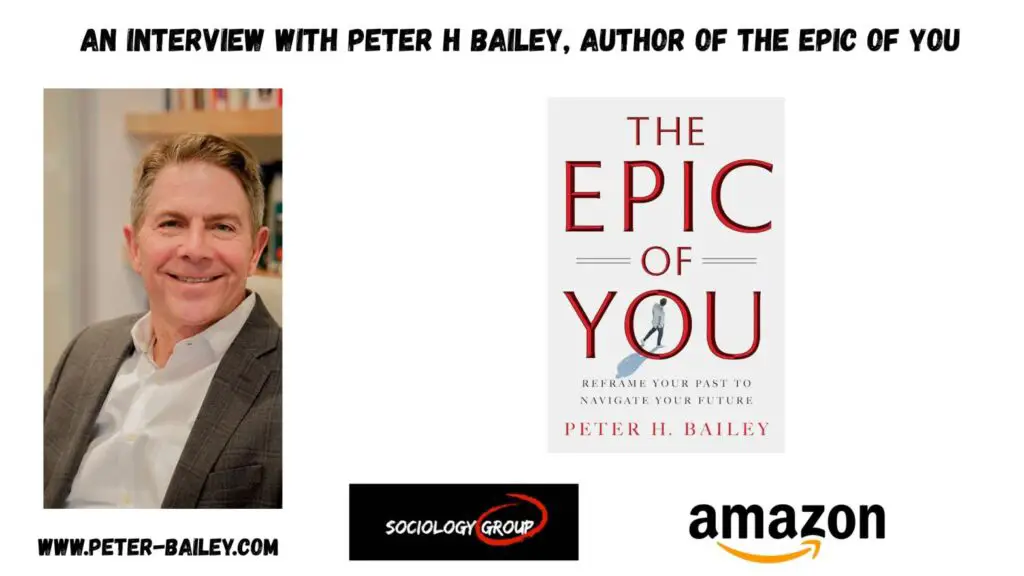
A TEDx speaker on “Developing Your Heroic Journey Mindset” and award-winning global educator, Peter has delivered leadership programs worldwide and previously ran a corporate training adventure center in Indonesia. He holds a Master’s in Experiential Education, serves on the Board of Voyageur Outward Bound School, and writes regularly on human performance and personal transformation.
Fluent in Indonesian and conversational in German, Peter brings deep cultural awareness shaped by extensive travel, including multi-month overland expeditions across Asia, Europe, and Africa. His personal pursuits are as wide-ranging as his professional work—rock climbing, sailing, scuba diving, dog-sledding and fly-fishing.
His attempt to learn the instruments of cultures around the world prompted him to learn the didgeridoo from Australia, playing the chanter from Scotland, and the low whistle from his time in Ireland are examples of his curiosity and love for life!
Peter’s upcoming book, The Epic of You, invites readers to see their lives in a new light. By reframing past experiences, Peter discovered “honey to my heart” in the hardships that deepened his compassion, and “strength to my arm” in the challenges that built resilience and fortitude. He believes every choice (made or missed) shapes who we are, and that viewing life as a Heroic Journey can help anyone reclaim authorship of their story and live a richer, more purposeful life.
Welcome to our interview series, Peter. To begin, could you describe yourself in a few words, in your own way?
I am a life-long learner with 45 years in the leadership and human performance improvement field, working, living and travelling through 50 countries, with a deep desire to help heal the world through bridging hearts and minds, through understanding and a little humor!
You’ve worked across more than 50 countries. When you look back, what has traveling and working across cultures taught you about people that no textbook ever could?
As fellow humans we have a deep connection to each other through shared similarities…but understanding the differences we do have are critical to building bridges to trust, collaboration, and partnership.
After four decades in leadership and facilitation, what still excites you the most when you walk into a room to work with a new group?
Possibility!! I love meeting a new group of people and looking for ways to spark their imagination, possibility for creative solutions, and hope for the future.
As President of The Prouty Project, you help leaders and teams navigate change. In simple terms, what do you think organizations often misunderstand about real transformation?
As leaders we have to create an environment to help people bring their best selves. Too often pursuit of revenue and focus on the business overshadows the critical need to establish a culture of engagement, growth and empowerment.
You often describe yourself as a “change agent.” What does meaningful change look like to you, both in organizations and in everyday life?
I often say, “It’s not that people don’t like change, they don’t want to BE changed.” Which means for successful organizational change we need to inspire people with the possibility, importance and relevance of the change, enroll them to help take ownership of ways to bring change about and do so with an appreciation for the different ways people go through change.
Your car license plate says “CREATE.” What does that word mean to you on a difficult day, not just a good one?
Creativity is a mindset. It is a way of seeing the world as an opportunity to approach life with awe, wonder and enthusiasm. Life is about the people we meet and the experiences we have, and what we do about them. Every single interaction is a test of our ability to choose our reaction to an experience. Do we bemoan our fate and curse the heavens when we get a flat tire, or do we take a deep breath and say “Hey kids, ever changed a flat tire before?!” I have tried to live by G.K. Chesterton’s quote: “An adventure is only an inconvenience rightly considered. An inconvenience is only an adventure wrongly considered.”
The Epic of You frames life as a Heroic Journey. When did you first realize your own life could be seen this way?
It wasn’t until I was in Graduate School that I was introduced to the Heroic Journey but it had a profound impact on me and how I chose to live my life from that point forward. And I learned, I was able to live it “backward” by seeing how the Heroic Journey mapped my entire life when I retold every experience as a particular stage of the journey.
You write about finding “honey to my heart” in hardship. How did struggle deepen your compassion rather than diminish it?
Early on, I saw the difficult things in my life as weaknesses, assaults and affronts to my forward movement. But in hindsight, I was able to look at the painful parts of my life as teachers of tenderness and laboratories of learning. It is easier to hate, fear and protect, it is harder to love and soften our hearts to be caring beings in any circumstance. When we live that way, the cosmos conspires on our behalf. For example, one time when I was living in New York City, I literally had no more money and put my very last dollar bill in a 12-step collection basket. I surrendered to “The Powers That Be.” When I walked up the steps from the church basement, I found two dollars on the street in front of the building. Moments like these confirm that we can turn hardship into opportunities. I now am much more aware of what people are going through on the streets every day.
Rumi has a wonderful sonnet that speaks to this burgeoning awareness, roughly paraphrased: “I lived for thousands and thousands of years as a mineral, and then I died, and became a plant, and I lived for thousands and thousands of years as a plant, and then I died and became an animal, and I lived for thousands and thousands of years as an animal and then I died and became a human being. What have I ever lost by dying?”
Many people feel stuck because of past choices or missed chances. What would you say to someone who feels their story is already written?
As someone who has lived through divorces, addictions and loss, I know the depths to which I have descended when I felt the pain of regret, remorse and grief. However, if we are still alive, we still can choose how we want to live this moment, and the next, and the next. While it may seem difficult to turn our energies towards more positive manifestations, it is not impossible. For anyone. It simply requires a fundamental shift in mindset. In Twelve Step programs we speak of not being able to begin recovery until we fully hit bottom. We say we hit bottom when we stop digging. For some people, they never stop digging. But for others, we reach a point where we can’t do it anymore. We put down the shovel. We look up from our hole to the light….and we begin the journey to a new way of living.
Addiction, recovery, grief, and love are all part of your journey. How did facing these experiences shape the leader you became?
Addiction: Addiction helped me to see that we can’t do this life alone. I need help. I have to reach out and look for support from people who have been this way before, and I in turn, need to be willing to offer my help to others in need.
Recovery: Recovery is a practice. They say it is “a daily reprieve contingent on the maintenance of our spiritual condition.” Therefore I need to sustain and deepen my daily practice and spiritual condition if I want to achieve it.
Grief: Grief has many forms. It might sometimes look like sobbing uncontrollably, and other times, a heavy longing or missing of someone or something that was truly important. There can be an ongoing heavy loneliness that becomes the overcast skies of a grey existence. Knowing everyone has something difficult that they are dealing with has helped to develop my empathy for them and their unknown situations.
Love: As corny as it may sound, love is truly the answer. I try to communicate how much I care for people in every interaction. I will memorize the names of 30 people in a room in the first two minutes when I meet them to convey that they are important and worth learning their names.
Joseph Campbell’s Hero’s Journey can sound mythical. How do you explain it in everyday language to someone encountering it for the first time?
Yes, the Heroic Journey can seem mythical, but it is truly just the noticing of a lifecycle happening around us everyday. Every big choice we make has consequences. We are preparing ourselves through diet, exercise or learning for some unknown future. We get an invitation or a “call” to do something. We might talk with allies to decide if it is the right thing to do. We decide and despite barriers launch into a new thing, where it gets hard and we learn something from it. We come back and tell people about it. That is the journey. I am convinced that this simple framework maps elements of everyone’s lives. When viewed through a lens of the mundane, it can seem pedestrian. When viewed through the kaleidoscope of the Heroic Journey metaphor, it is magical and magnificent!
In your work with teams, what is one small shift in thinking that often leads to a big change?
I think the single most useful tool to first build a stronger cohesive team is to elevate the awareness and skill of Emotional Intelligence. I have seen miraculous changes happen as people become more aware and improve how they understand and see themselves and better understand others so that they can communicate with them in elevated ways.
You emphasize experiential learning. Why do you believe people learn more deeply through experience than through instruction alone?
I believe that experience plus reflection equals real education. I define experiential learning as the maturation of choice. If I improve my choice-making skills, then I will more likely have better choices from which to pick. If I take time to reflect on what makes my choices better, weigh consequences of my actions and strive for the summum bonum, the highest good I can do, I am more likely to have more positive and beneficial outcomes. This experience can be read about or learned through instruction, but it doesn’t really stick until it is lived. That is why our leadership and strategic planning sessions help people see themselves, their attitudes and behaviors through small challenge activities that are illuminating. Awareness is the first step before change and transformation.
What have global teams taught you about listening, especially when people come from very different cultures?
I have learned so much from working with global teams. One of the most significant ways I have learned to listen to people from different cultures is not in what they say, but in what is not said or is communicated through body language. A friend and mentor in Singapore once said, “what is not said is often louder than what is said.” The more carefully I pay attention to the messages around what is being said– the context as well as the content, the better I will understand what people are trying to communicate.
The Epic of You is part story and part guide. How do you hope readers will actually use the book in their daily lives?
My hope is that people will read my story and see their own story more clearly in terms of the people they have met and the experiences they have had. It gives them a framework for understanding not only what has happened to them, but what it did to them, and what they did with all of that. And, going forward they can live more expansively by taking ownership of their responses to the gifts and challenges of their lives. The book is not called the Epic of ME, it is the Epic of You…it is your story that is even more important!
For someone standing at a crossroads and afraid of making the wrong choice, what message from The Epic of You would you want them to hear right now?
Take a deep breath. Look up at the sky. Take it all in. Reach down and touch the ground…listen for what your inner voice is telling you. Seek counsel from others, not for what they tell you, but what you say as you speak with them. Listen to how your story evolves each time you speak with someone. How are you describing your crossroads? What are you drawn to? What is calling you? What is emerging in you. What is crying out to be answered? Go forward with that knowledge. A wise woman once told me, “All is well and all will be well.” Trust that.

We believe in sharing knowledge with everyone and making a positive change in society through our work and contributions. If you are interested in joining us, please check our ‘About’ page for more information