
About Author: Kym Coco is the founder of Swagtail, a platform created to share the mind–body techniques she uses to thrive in her own life. Many of these approaches were overlooked during her master’s studies in sports kinesiology, despite their real-world impact.As science has evolved, so has our understanding of the powerful connection between thoughts, emotions, and physiology. Drawing on both research and lived experience, Kym’s work is rooted in making these insights accessible and practical. Her goal is to save others countless hours of classroom time and significant tuition costs while guiding them toward a more focused, energized, and intentional way of living.These ideas come together in her new book, Miracle on the Mountainside, where she explores transformation through the lens of mind–body awareness and purposeful living.
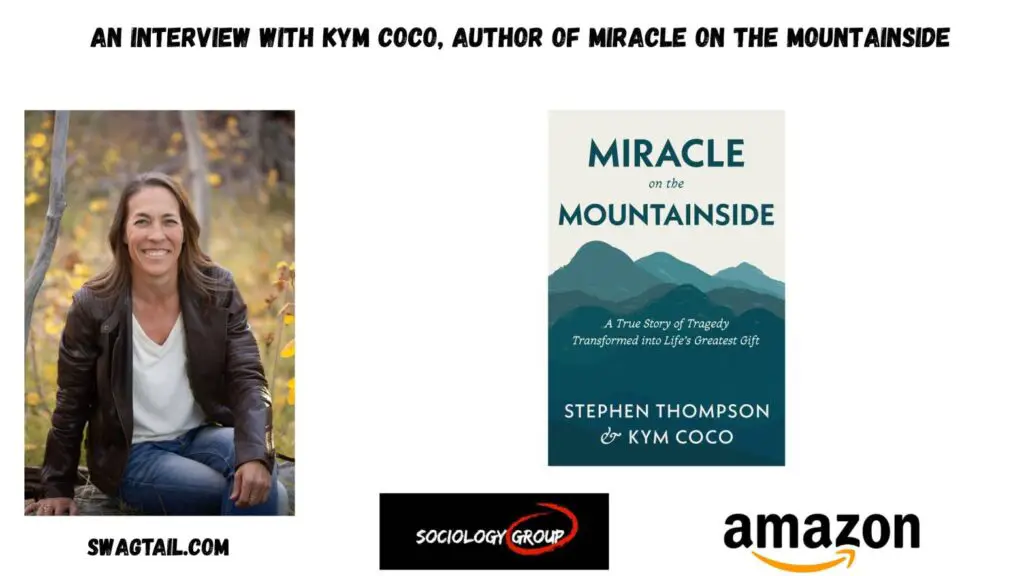
Welcome to our interview series, Kym. Thank you for joining us. To begin, could you share a little about yourself and what led you to create Swagtail and the kind of work you do today?
Hello, and thank you so much for inviting me to be here with you today. I’m Kym Coco. Author. Nature-loving yogi. Dog mama to two English Staffies, Kai and Luna. I have a Master’s Degree in Sports Kinesiology, and two 500-hour Yoga Teacher Training Certificates. I wove both topics into the classes I taught at California State University, Chico, and in the workshops I led with my late husband, Stephen Thompson. Yet I wanted a broader way to share my knowledge on how to find mental, emotional, and physical balance. That’s why I started my blog, Swagtail.com, about seven years ago. I stepped away from writing there for a few years, as full-time caregiving was in order. Now, I’m thankful to be back with my community. Plus, I’m eager to share about the memoir I just finished about Steve’s Life, entitled Miracle on the Mountainside.
You created Swagtail to share mind-body techniques you didn’t learn in your sports kinesiology program. What moment made you realize these missing tools were essential for a healthier and more intentional life?
First, I’d like to say that my foundation in kinesiology, or the study of human movement, provided an excellent basis from which to understand body awareness, alignment, and physical tools for vibrant health. Then, just as I was about to enter my master’s program, I started a regular yoga practice. I was fascinated with how breathing and present-moment awareness impacted my well-being. This was also the same time a colleague introduced me to Stephen Thompson. Steve worked in the field of emotional kinesiology. He utilized the body to detect emotional blocks, remove them, and restore balance to one’s system. These two events–starting yoga and meeting Steve–were powerful catalysts for my last two decades of study in the mind-body realm, and Swagtail is a fun way for me to pass that learning on to others.
Your yoga background shapes so much of your approach. How has yoga influenced your healing, your writing, and the way you move through everyday life?
You’re absolutely right that yoga influences my approach to all aspects of life. Since yoga is an often misunderstood concept, let me give my definition of it before I go further. I view yoga as a collection of techniques to harmonize the body, mind, and spirit. It’s a path through which we can access more of our power in any given moment. When we learn how to do this, we can experience a sense of effortlessness, freedom, and enhanced perception. It’s what athletes call “the zone.”
Only the flow state is unlike a college degree, where once you find it, it’s yours forevermore. Life is constantly changing. So are our bodies, relationships, and emotional states. Yoga reminds me to view these changes from a broader perspective. I can see them from a more non-judgmental state. I can also appreciate the moment in light of the big picture, and keep a sense of humor and playfulness in my approach to whatever task is at hand. This is true for the incremental steps I take to care for my body as well as the focus I bring to my writing.
In simple words, how do our thoughts, emotions, and body work together, and how does this connection show up in Miracle on the Mountainside?
This is a great question because our body, thoughts, and emotions do work together. First, our body’s senses–like seeing, hearing, and smelling–interpret vibrational data from the world around us. Those sensations trigger a thought, and almost just as quickly, an emotional response to that input. If we pay attention, those emotions are evident somewhere in the body. It could manifest as a smile on your face or a sense of tightness in your chest. It just depends on your perception of that information.
Many times, people simply react to their environment. If something is pleasurable in the environment, they lean in. Yet if they encounter something unwanted, they resist it, avoid it, or numb the pain that comes from the cascade of thoughts and feelings that result from it.
Yoga and mindfulness practices teach you how to put a gap between the stimulus and response. It allows you to view a situation from a neutral place, gain clarity about how to proceed, and have more power in the choices you make moving forward.
In the case of Steve’s life, he discovered this gap was possible after his motorcycle accident. After the miracle rescue, his body required twenty-eight reconstructive surgeries and a six-year period to learn how to walk again. He found himself in countless unwanted circumstances. When Steve learned that he could love himself–and his life–regardless of those conditions, his healing process accelerated dramatically.
What inspired you to write Miracle on the Mountainside, and why did you feel Steve’s story needed to be shared now?
For those of you who don’t already know this, Steve started out as my colleague for a few years. We met over a decade after his full recovery, and I knew the story of his complete transformation. I found it inspiring. So did his students around the country. Steve was a living example that the techniques he was teaching really worked.
In any case, Steve and I soon realized the unique nature of our bond, and we risked our friendship for something more. This led to thirteen wonderful years of marriage. Yet Steve became very ill the last three years of our time together. We reorganized our priorities and simplified our schedules. Only one thing remained on our daily to-do list: have meaningful conversations. In many of these interactions, Steve reflected on the lessons he learned over the course of his life. I promised to turn these stories into a book one day. That gave him a sense of purpose in his final days, and it gave me one once he left his body.
I’m so proud to share Steve’s stories with you in Miracle on the Mountainside: A True Story of Tragedy Transformed into Life’s Greatest Gift. I think the timing of the book’s release couldn’t be better. We live in a cultural period where uncertainty and overwhelm are running rampant. Steve’s insights offer an opportunity to view our experiences through a new lens and embody our potential. The best part is that we don’t have to go over a cliff, like Steve did, to embody that wisdom.
For readers who never met Steve, what was it about his humor, energy, or presence that made him so vibrantly alive?
Steve was adventurous, independent, and value-driven throughout his life. You see this in the book’s chapters about Steve’s early years. Then, at age forty, his life turned upside down. Three years in a hospital bed changed his relationships. A slow, more methodical approach to rebuild his future did, too. This taught Steve’s presence at an entirely new level. And you felt that with him.
One of my favorite quotes is, “Attention is our currency of love.” In Steve’s company, you felt seen and accepted. He genuinely cared for your well-being, and he listened to you from the heart. His sparkling eyes and perfectly timed humor added a playfulness to these interactions that was unforgettable.
When you revisited the details of Steve’s accident and rescue, what part of that experience still feels unbelievable or deeply moving to you?
This is a great question, and almost every part of Steve’s accident story is fantastical. He was on a motorcycle ride up a mountain highway when he unexpectedly hit shale. His bike hit the guardrail, and in an attempt to avoid being crushed, Steve tried to jump the barrier. Only this sent him tumbling down a seventy-foot cliff. I still can’t imagine what it would be like to find myself immobilized and profusely bleeding in such a remote place.
In the moment of surrender on the side of the mountain, Steve also had a vivid near-death experience. He described feeling a peacefulness so intoxicating that he didn’t want to leave, even though he couldn’t explain where he was. In that space, Steve was given a choice to return to his body or not. No rush to make that decision. No right or wrong way to move forward. I find the reasons he chose to come back intriguing. And I think readers will, too.
Steve’s near-death experience changed his view of life. What do you think is the biggest spiritual or life lesson readers will take from Miracle on the Mountainside?
You’re absolutely correct. Steve described his time out of body as being plugged into a supercharger of well-being, and it was a way he was able to fully embrace the unconditional love of the Divine. Call it God. Call it Source Energy or All-That-Is. Steve didn’t care about labels. He just knew he was one with that harmonious force, and he was curious about bringing it back into as many of his human experiences as possible.
Did that make Steve infallible when he returned to Earth?
Not quite. But it did give Steve clarity about what it meant to be an eternal being. It gave him a greater understanding of what it meant to be an authentic and compassionate person. Better yet, Steve discovered that it was possible to tap into the infinite flow of well-being on purpose. And when he did, miracles occurred more and more.
Miracle on the Mountainside reminds us that we’re all capable of aligning with energy and experiencing a satisfying life experience now.
You promised Steve you would tell his story. How did honoring that promise shape your writing process emotionally, spiritually, and personally?
Steve and I talked about everything in his final days. This included the tips he shared with his own clients going through grief and loss. His aim was to prepare me for life without him. One thing he told me at the time was that I would need structure in my life. I’d need something to give me purpose every day. Writing Miracle on the Mountainside was a great way to channel my focus.
On an emotional level, it gave me a greater appreciation for Steve’s personal journey. Many of his stories still have me shaking my head in amazement. The resilience and strength he had through his challenges reminded me to tap into that reservoir of my own when grief hit hard. On a spiritual level, the vast nature of our beingness kept my sadness in perspective. I was able to let the emotions flow, without resisting them, and appreciate them as part of the learning on my own path. Personally, writing a novel was far different than the how-to texts I’d written in the past. Sure, those were sprinkled in with stories to illustrate important points. Yet crafting scene descriptions and evocative dialogue was completely new. I found it exhilarating!
As someone trained in yoga, kinesiology, and mind-body science, how did your professional background help you understand Steve’s recovery and transformation?
With 6 years of formal training in how the body operates, I could comprehend the magnitude of Steve’s injuries and ensuing recovery. Bones broken in 110 places? Tissue transplants from the chest to the leg? Multiple skin grafts and replaced joints? These are all conditions that require lots of time for healing. Steve didn’t have the same training as I did and was often surprised at how slowly he made progress back to health.
I know Steve dealt with incredible pain as a result. That alone can spark a downward mental trajectory. On top of that, many elements of Steve’s identity, such as business owner, father, husband, friend, were stripped away all at once. That increased his sense of isolation and depression. From my vantage point, I find his grit and recalibration absolutely remarkable.
What was the most challenging part of writing Miracle on the Mountainside, and what helped you stay grounded during emotional moments?
The most challenging part of writing Miracle on the Mountainside was combating the sadness I had missing Steve by my side. I found that writing by the ocean was soothing to my soul. I’d walk the dogs on the beach at sunrise to stay grounded. I’d listen to the incessant waves pounding the shoreline—a reminder that there really is a harmonious, constant flow to life. And, I’d take time away from the book to cry a day if I needed it. Other times, I’d leave the writing process entirely for a few weeks to regain my own perspective. Mostly, I found a lot of quiet space out in nature to be the most healing.
With so much stress and uncertainty in the world today, why do you think a story like Steve’s, rooted in resilience and spiritual insight, is especially meaningful right now?
You’re absolutely right. There is a lot of stress and uncertainty in the world today. Technology is changing fast. How we communicate is, too. It can feel impossible to keep up, and it’s tempting to doubt if we’re making the best decisions for our families, our businesses, and our communities. Steve’s story lets us know we’re not alone in the quest for excellence. We all seek clarity and meaning in our lives. Yet even in this limited time-space continuum, we have incredible resources at our disposal. His story shows that we can tap into them now. And we can experience the immediate benefit of more inner peace as we do.
Swagtail.com offers practical tools for well-being. Which resources from your site would you recommend to readers who want to apply the lessons from the book?
The first resource I recommend is the book Steve and I had published back in 2012. The title is, It Just Makes Sense: 7 Principles for a Joyful and Stress Free Life. We get that stressors will never disappear entirely, but there are common-sense techniques to stay balanced when encountering them. Think of that book as a how-to guide for the lessons that are illustrated in Miracle on the Mountainside. You can purchase it through the website, Amazon, or anywhere books are sold.
The second place I’d direct you to on the website are the breathing and meditation articles. These are techniques Steve used to get well and ones I use daily for alignment. I explain what these practices are and how they provide you benefit. There are also follow-along videos with many of them in case you want to try them at home.
What do you personally hope readers feel or understand about themselves after reading Miracle on the Mountainside?
I like that you addressed the body and mind in your question. Knowledge is the precursor to transformation, so I’d like readers to understand what kinds of experiences are possible for them. Whether you’re interested in fine-tuning your attention, enhancing your intuition, deepening your spiritual values, or improving communication in your relationships, Steve’s stories highlight the incredible ways he learned to do such things. But my intention is that the ideas resonate on an emotional level, too. My hope is that you’re inspired by Steve’s life. I’d like his stories to make you laugh and appreciate your special journey all the more. As Steve often said that “Each of us is a unique and beautiful person and the Universe is blessed by our presence.” My intention is that each reader celebrates that within themselves.
As the release approaches, how can people stay connected with you, receive updates, and explore your teachings and well-being resources?
The release date for Miracle on the Mountainside is December 15th. Print versions are available on Amazon, and the audio version will be up at Audible. You can also visit Swagtail.com, click on the top banner that says “What’s the latest?” and enter your information there to stay in the loop. You can also click on the Free Resources tab to get a whole host of bonus documents, meditations, and videos that support the book.
Again, I want to thank you for having me here today. It’s been a pleasure to share about a man so special to my heart, and the threads of life that continue to make mine so meaningful.

We believe in sharing knowledge with everyone and making a positive change in society through our work and contributions. If you are interested in joining us, please check our ‘About’ page for more information