
Author Bio: Brandon Schomberg, PT, DPT, OCS, SCS, CSCS, is a board-certified orthopedic and sports physical therapist who helps people move better, recover from injuries, and stay active. He leads physical therapy clinics in the Twin Cities west metro and is passionate about making movement simple and enjoyable. Brandon is the author of Healthy Living With Your Dog, a guide that teaches you how to stay healthy and injury-free while staying active with your dog.
1. To begin, could you share a little about yourself and the journey that brought you from physical therapy and military service to becoming an author and wellness advocate?
Absolutely. I’m Brandon Schomberg, a Doctor of Physical Therapy, board-certified in both Orthopedics and Sports, a residency director at Twin Cities Orthopedics, and a proud officer in the Minnesota Army National Guard with over 20 years of service. My career has always centered around helping people move better, live better, and stay ready for the demands of everyday life, whether that’s on the field, in the clinic, at home, or in service.
Over the years, I’ve treated thousands of patients across all ages and activity levels, and one pattern became impossible to ignore: so many people were getting injured while doing very normal, everyday things with their dogs. So many come to mind. Slipping on a walk. Getting pulled by a leash. Twisting a knee while picking up a ball. Shoulder injuries from throwing too much. Back pain from leaning, lifting, or carrying. Even overuse injuries from suddenly trying to “get active” with a high-energy dog.
I found myself giving the same guidance again and again, such as tips for safer walking, mobility routines before play, strengthening strategies, simple ways to prevent aches and strains, and I realized there was a real need for a resource families could use before injury happened.
That’s where the idea for the book started.
At the same time, my military experience taught me the importance of readiness, routines, and resilience, and my own dogs, especially my active Vizslas, Edison and Peach, showed me firsthand how powerful the human–dog bond is for building a healthier life.
Combining physical therapy, sports medicine, dog ownership, leadership, and years of listening to patients, becoming an author felt like the natural next step. I wanted to give people a friendly, science-backed, easy-to-use guide that helps humans and dogs Move Better Together, prevent injuries, and build healthier habits that actually fit into real life.
“Healthy Living With Your Dog” is my way of bringing the clinic, the military, and the trail into the hands of families everywhere so they can live healthier, happier, injury-free lives with the dogs they love.
2. You often say “wellness is social.” What does that mean for everyday people who want to feel better and move more?
“Wellness is social” means we thrive when we do life with others. This includes our family, friends, coworkers, neighbors…and yes, even our dog(s).
Movement becomes easier when it’s shared. A walk with your dog. A workout with a friend. A stretch break with a coworker. Those little social anchors create routine, accountability, and meaning.
In the book, I talk about this often: when movement becomes part of your relationships, it stops feeling like work and starts feeling like living.
3. How do dogs naturally help us build healthier routines and stronger connections with people around us?
Dogs do something incredible: they pull us into movement without us realizing it. They nudge, they pace, they wait by the door. They create joy and happiness each day.
But they also pull us into the community. Walk a dog, and suddenly you’re greeting neighbors, chatting at the park, having micro-moments of connection that we desperately need in a busy world. It’s such a joy to see a sea of people out enjoying a walk with their dogs on a beautiful day.
Your dog becomes your “movement partner” and your “social bridge.” That’s the essence of Move Better Together.
4. What changes have you seen in a person’s daily activity or mood once they start walking or playing with their dog more often?
One of the most immediate changes is energy. People start to feel lighter, clearer, and more purposeful. Mood improves, stress decreases, and sleep quality often goes up by getting your body to move more.
And from a physical therapy perspective, the step count, mobility, and joint health also improve. All from the simple act of moving with their dog. It’s a simple strategy.
It’s why one of my early recommendations in my book is:
Start with small, consistent human-dog micro-moments of movement. They compound fast and create inertia.
5. How do dogs help reduce loneliness and bring people into their communities?
Dogs create instant conversation starters. They turn a silent neighborhood into a place of smiles and quick chats.
Many people tell me they’ve met more neighbors in one month of walking their dog than in five years of living somewhere.
Dogs remind us that connection is built on small moments, not big events. Active lives are happy lives, and they create more fun.
6. Why do you believe small rituals like morning walks or stretching can be more powerful than big workouts?
First off, all movement with the proper progression should yield positive results. Because small rituals are repeatable, they build identity and momentum. Over time, you build a strong core and fortify your foundation, which are tips in the book to help guide you.
Big workouts are great, but they require motivation, a longer time, planning, and more energy. Life can be hectic for all of us, and each day fluctuates, making it easier to find excuses to avoid a workout.
Small rituals like a 10-minute walk with your dog, squats in the morning, or a stretch before bed? You can do those anywhere, anytime, with little time commitment.
In Healthy Living With Your Dog, I call this “Movement is Medicine,” and it is your foundation for long-term health and success.
7. How can seeing yourself as an “active person” or “dog parent” motivate long-term healthy habits?
Identity drives behavior. When someone starts to think, “I’m the kind of person who moves with my dog,” their choices align with that identity. They woke up earlier. They protect their walks. They try new activities. Your dog becomes part of your lifestyle, not an add-on. That shift is powerful. You look forward to that movement as your body starts to crave it, you release more positive hormones, you feel better, and your dog also thrives in that symbiotic environment.
8. What are a few 10-minute habits humans and dogs can start together that make a real difference?
Here are “Move Better Together Wins:”
- 10-minute sunrise or sunset walk
- 4-minute joint warmup + 6-minute leash walk
- 10 toss-and-retrieve reps (movement + bonding)
- Couch-to-yard routine: 5 minutes of inside stretching, 5 minutes of backyard play
- Evening de-stress walks to lower heart rate and improve sleep
These are other tips in the book that are simple, repeatable, and effective with little time.
9. Can you share one simple warmup or mobility routine that both people and pets can enjoy?
Absolutely. Here’s my go-to “Human + Dog Dynamic Warmup”
Human:
- 10 marching steps
- 10 walking lunges
- 10 arm sweeps
- 10 air squats or sit-to-stands
Dog:
- Slow sniff-and-walk that is great for the nervous systems
- Figure-8 leash pattern to help multiple muscle groups
- Playtime on the ground for core and snuggles
- Light play with a ball or frisbee, or a quick game of fetch
It prepares both bodies for movement and reduces the risk of overuse injuries.
10. What does a “Paw’pared” health check look like for someone new to dog fitness?
I created the “Paw’pared Checklist” to help owners be prepared and start safely on every walk or adventure. It includes:
- Must have essentials: Leash, snacks, reflective gear, etc.
- Exercise gear recommendations for the go-bag
- Weather considerations
- Other options are optional, but highly recommended, for longer walks or hikes.
It’s simple, keeps movement safe and injury-free, and is a highlight of the book and the website, available for free.
11. How can play rather than strict exercise help people stay active without feeling pressured?
Play removes the pressure of “should.” It brings back joy, spontaneity, and curiosity.
When you play with your dog, fetch, tag, exploring, and light running, movement becomes something you look forward to, not something you dread. Keep it simple.
This is one of the core Move Better Together principles: Joy is a better motivator than discipline.
12. What early warning signs of overuse do people often miss in their own bodies?
The most common signs people ignore include:
- Morning stiffness that lasts more than 10–15 minutes
- One-sided soreness or achiness
- A decrease in stride length or loss of balance
- “Nagging” pain that returns every few days
- Needing longer warmups than usual
My physical therapy advice: listen early so you don’t heal late. Your body gives you micro warning signs, so listen to those subtle cues before an injury occurs. I have a tip for getting to know your body so you can marvel at and appreciate it.
13. What signals show a dog may be tired or pushing too hard, and how can owners respond?
Watch for:
- Excessive panting
- Lagging behind
- Paw licking
- Sudden stubborn behavior (it’s often fatigue)
- Less enthusiasm on the next walk
If you see these, cut the session short, hydrate, get in the shade, and rest. Dogs give subtle signs; we just need to catch them. Tip number one in the book is to stay alert and stay safe!
14. Your career spans PT, sports medicine, military service, and dog ownership. How did these shape your mission?
All four taught me this: Movement is freedom.
In therapy, I saw how movement heals. In sports, I saw how movement performs. In the military, I saw how movement preserves readiness. With dogs, I saw how movement strengthens connection.
Those worlds came together to form Move Better Together, a mission grounded in science, service, and everyday life.
15. “Move Better Together” is more than a slogan. What does it personally mean to you?
To me, Move Better Together (MBT) is a reminder that life, at its purest, is a team sport. We are better when we move and when we move together. In my world, it’s my family, my soldiers, my patients, my colleagues, my neighbors, and my community. I can’t forget it’s my dogs, Edison and Peach, who remind me daily that joy and health grow when shared.
16. You started writing your book during deployment. What real-life moments inspired it?
Deployment strips life down to what matters: family, health, connection, routine, and purpose.
It was my many patients over my 15+ years of physical therapy to date that inspired it. Listening to their stories and their passion for their dogs… hearing the joy (and some fear on occasion) in those injury stories. Seeing how movement and companionship shaped morale for both civilians and soldiers deployed, and it’s often taken for granted. Being deployed, away from my closest circle, left me with time to reflect and sparked the earliest pages of the book.
It became my way of staying connected to home and turning challenge into purpose to help get the word out.
17. What key message do you hope readers take away from Healthy Living With Your Dog?
That you don’t need perfection, you just need partnership.
Movement becomes easier when it’s shared. Dogs can be the most consistent wellness partners we’ll ever have.
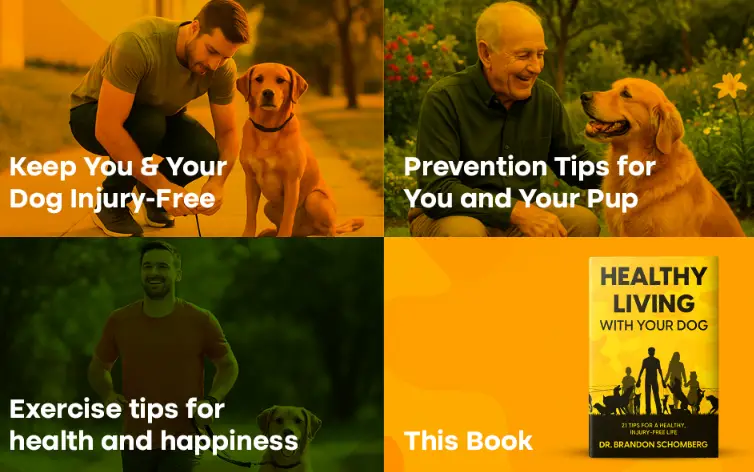
If readers walk away believing, “My dog and I can live healthier, happier lives together,” then the book did its job. You and your dog will continue to share love on your adventures. I call this dog + exercise = dog’ercise in the book! Be active and dog’ercise!
18. Holidays can be stressful. How can dogs help families stay calm, connected, and active?
Dogs keep us grounded. They pull us out of the chaos and back into simple routines such as walks, fresh air, and play.
They also help regulate stress by boosting positive hormones, lowering cortisol levels, and providing families with a positive anchor during busy holiday weeks.
19. What usually gets in the way of movement during the holidays, and what simple solutions do you recommend?
Barriers:
- Travel
- Schedules
- Weather
- Family commitments
Solutions:
- 10-minute “reset walks” with your dog
- 3-move mobility routine before bed for your hip, back, and shoulders to start
- Family dog walks as a holiday tradition – Rain, Shine or Snow — My favorite!
- Short play sessions in the yard or living room during busy days
Small, joyful moments, that’s how you stay consistent.
20. For someone just starting their wellness journey, how can Move Better Together guide their first steps?
MBT gives people permission to start small and start together.
Through simple habits, preventive tips, and the practical tools in the book, such as warmups, checklists, and mindful routines, people gain a roadmap that’s doable, friendly, and grounded in real physical therapy science. The sample workouts will help you get started. The tips will keep you injury-free, and the accountability actions will keep you consistent and inspired. Just consistent movement with your dog is the key to healthy living together.
21. For audiences, organizations, or families who want to learn from you, what can they expect from your talks, workshops, or consulting?
They can expect energy, empathy, and actionable tools. I blend science, storytelling, and simple takeaways that families, teams, or organizations can use immediately.
Workshops can be tailored to cover: Injury prevention, Dog–human fitness, Workplace wellness, Leadership and readiness, or The MBT model of human connection. Everything ties back to one mission: Move more, connect deeper, and live healthier – together.


Check out this Amazon book: Healthy Living With Your Dog:21 Tips For A Healthy, Injury-Free Life

We believe in sharing knowledge with everyone and making a positive change in society through our work and contributions. If you are interested in joining us, please check our ‘About’ page for more information